
Sizing a 4–7.5 kW Micro Rotary Screw Air Compressor for Plastics, Packaging, and Automation
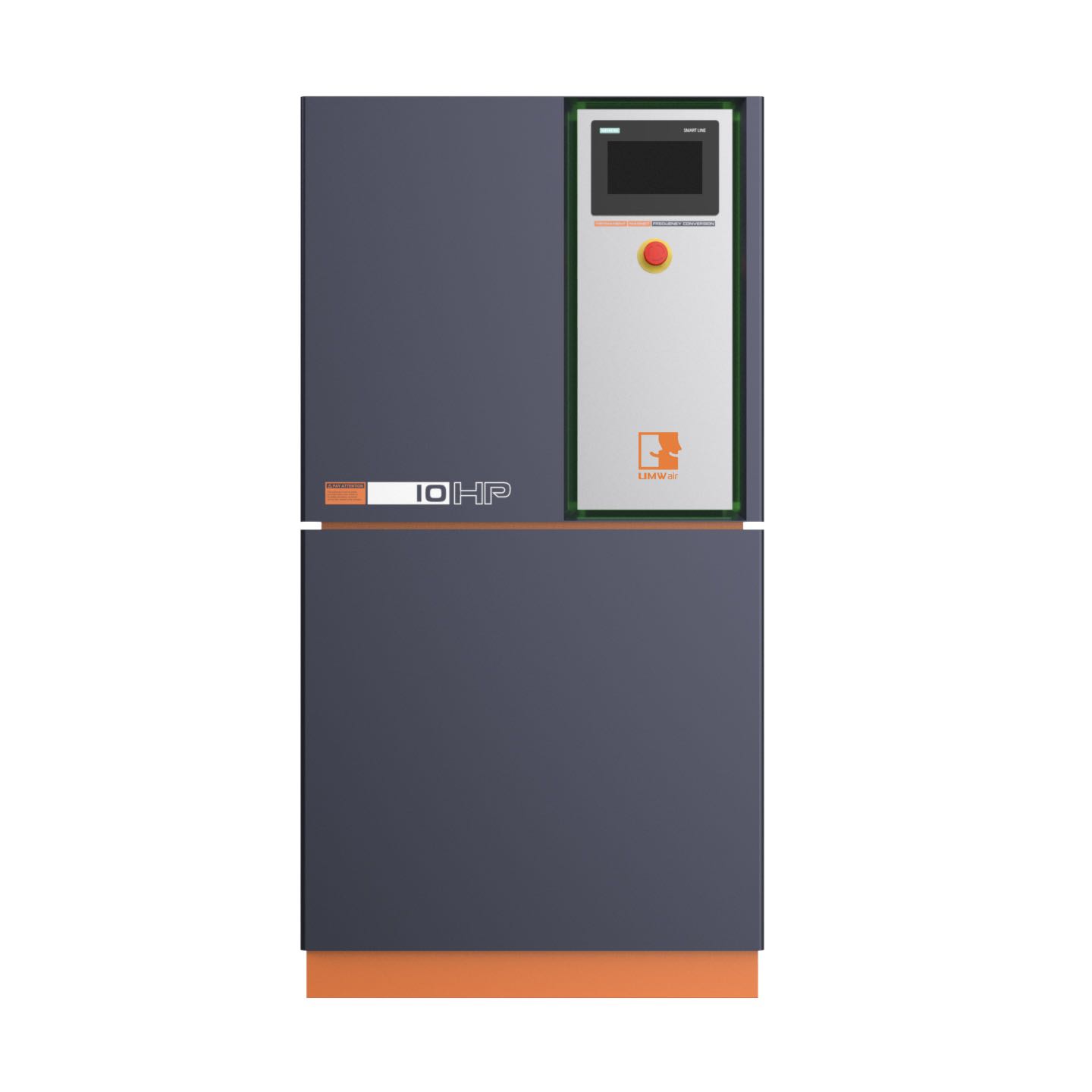
For a plastics processor, packaging line, or automation integrator, the practical question is not whether a rotary screw compressor is familiar. It is which compact package can deliver stable compressed air into a 4–7.5 kW project without creating new problems in space, noise, maintenance, or air quality. The UMW Air Micro series is positioned for that decision path, with the Micro ML-4A, ML-5.5A, and ML-7.5A mapping to 4 kW, 5.5 kW, and 7.5 kW power options.
This guide answers the project-fit question: how a micro rotary screw air compressor fits plastics and rubber processing, food and packaging, and industrial automation integration. It uses the supplied Micro series data: a 1.1 m³/min maximum series airflow, an 8–13 bar pressure range, a 140 L gas tank, a single-stage screw compressor air end, and sheet metal construction. It also explains the supporting equipment the scenario requires — air dryer, air tank, line filter, inverter, and controller — and the continuous-operation requirements for energy saving, low noise, environmentally friendly operation, and high reliability.
What Does a Micro Rotary Screw Air Compressor Solve in These Projects?
A micro rotary screw air compressor provides stable compressed air for a defined production area rather than for a whole plant. In the supplied application profile, that role covers CNC machinery production lines, automotive parts production lines, plastic processing line expansions, industrial automation integration, and food and beverage packaging line setup projects. The compressor is described for continuous operation, including high-temperature or humid environments that require stable and clean compressed air.
The decision is therefore narrower than a general compressor purchase. The buyer needs a package that matches the project’s power availability, pressure requirement, air-treatment plan, control architecture, and duty cycle. A mismatch can appear as unstable pressure at a CNC actuator, moisture carryover in a packaging line, or unnecessary energy use when the compressor is oversized for the actual demand.
Industry Context: Why Compact Rotary Screw Packages Fit Modern Production Lines
Rotary screw compressors are used across metal processing, plastics, automotive parts, electronics manufacturing, food packaging, construction materials, chemicals, and energy industries in the supplied application data. The same data lists the relevant project types as CNC machinery production lines, automotive parts production lines, plastic processing line expansions, industrial automation integration, and food and beverage packaging line setup projects.
The industry background that matters for selection is operational. These lines call for stable compressed air under continuous operation, and the application profile explicitly includes high-temperature or humid environments. That makes air treatment and package reliability part of the compressor decision, not an afterthought. The stated special requirements are energy saving, low noise, environmentally friendly operation, and high reliability.
For context, oil-filled rotary screw compressors accounted for 61.7% of 2025 market share, according to The Business Research Company. This does not make every project identical, but it explains why compact oil-lubricated screw packages remain a mainstream reference point for general industrial air. Where a food or packaging application has a contamination-sensitive air requirement, the buyer should confirm whether an oil-free configuration is needed; the supplied Micro series specification does not state an oil-free configuration.
UMW Air Micro Series: Model Mapping from 4 kW to 7.5 kW
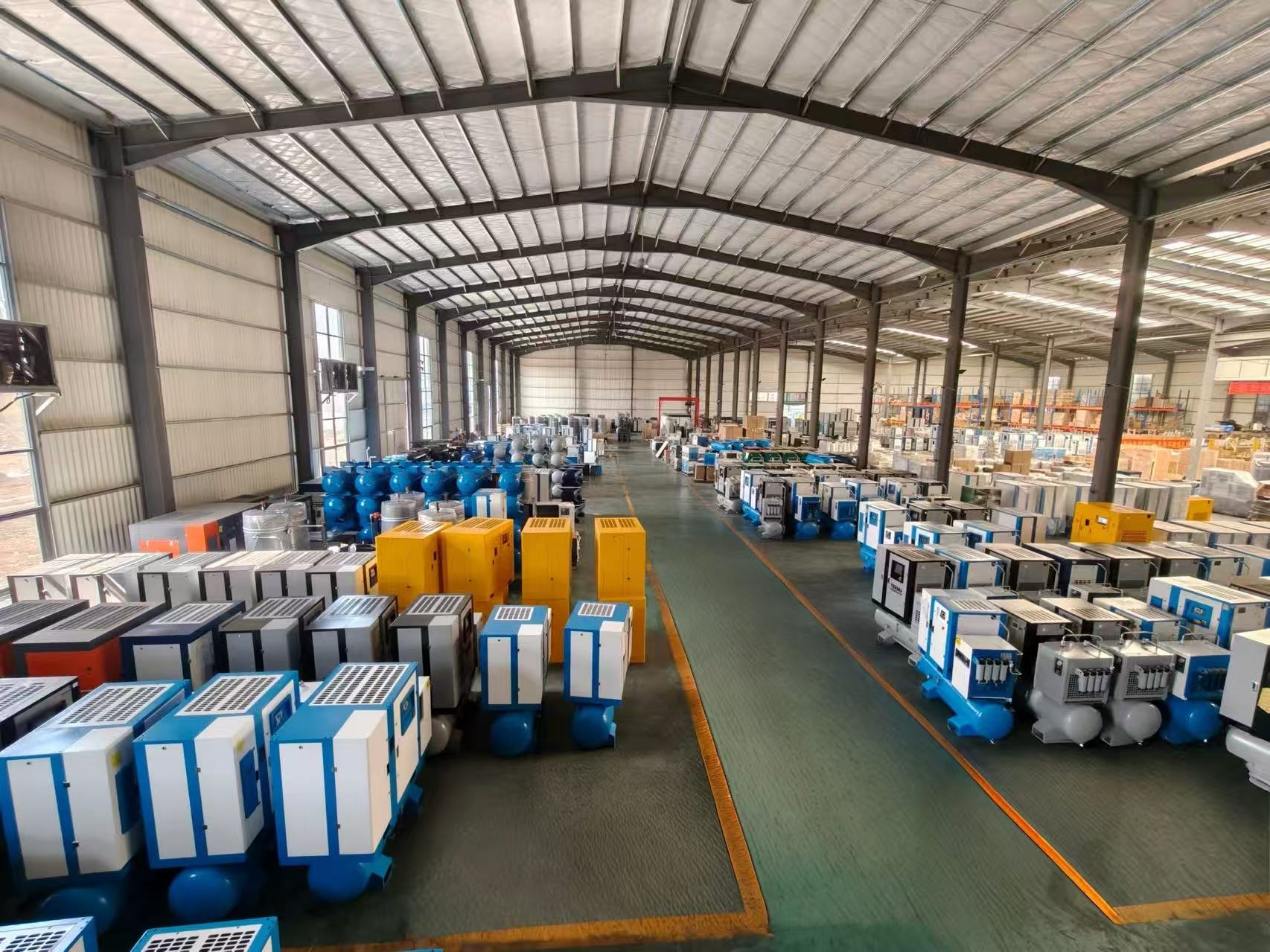
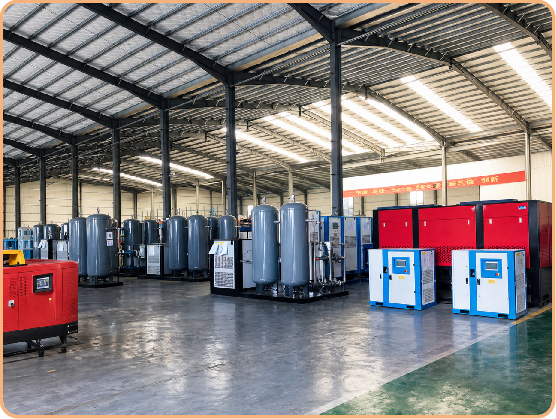
UMW Air is a compressor manufacturer whose published company information lists a 2,000 m² factory, 200 employees, and a 12,000-unit annual production capacity. Its Micro series is the compact rotary screw package relevant to this guide. The model mapping is direct: Micro ML-4A for 4 kW, Micro ML-5.5A for 5.5 kW, and Micro ML-7.5A for 7.5 kW.
Across the supplied series data, the Micro package is listed with a maximum airflow of 1.1 m³/min, a pressure range of 8–13 bar, a 140 L gas tank, a single-stage screw compressor air end, and sheet metal construction. The airflow figure is a series maximum. It should not be read as the delivered free air delivery of every model at every pressure. Before ordering, request the model-specific airflow at the required working pressure.
| Model | Power option | Series maximum airflow | Pressure range | Gas tank | Air end | Construction |
|---|---|---|---|---|---|---|
| Micro ML-4A | 4 kW | 1.1 m³/min (series maximum) | 8–13 bar | 140 L | Single-stage screw compressor air end | Sheet metal |
| Micro ML-5.5A | 5.5 kW | 1.1 m³/min (series maximum) | 8–13 bar | 140 L | Single-stage screw compressor air end | Sheet metal |
| Micro ML-7.5A | 7.5 kW | 1.1 m³/min (series maximum) | 8–13 bar | 140 L | Single-stage screw compressor air end | Sheet metal |
Table note: airflow, pressure, tank, air end, and construction are series-level data. Confirm model-specific performance and configuration in the quotation.
The table is useful for early project screening, not for final acceptance. A 4 kW, 5.5 kW, or 7.5 kW selection still depends on the required pressure, the actual air demand profile, and the air-treatment package. The Micro series data supports the power mapping and the shared platform facts; it does not replace a model-specific datasheet or factory test report.
Supporting Equipment Required for Stable, Clean Compressed Air
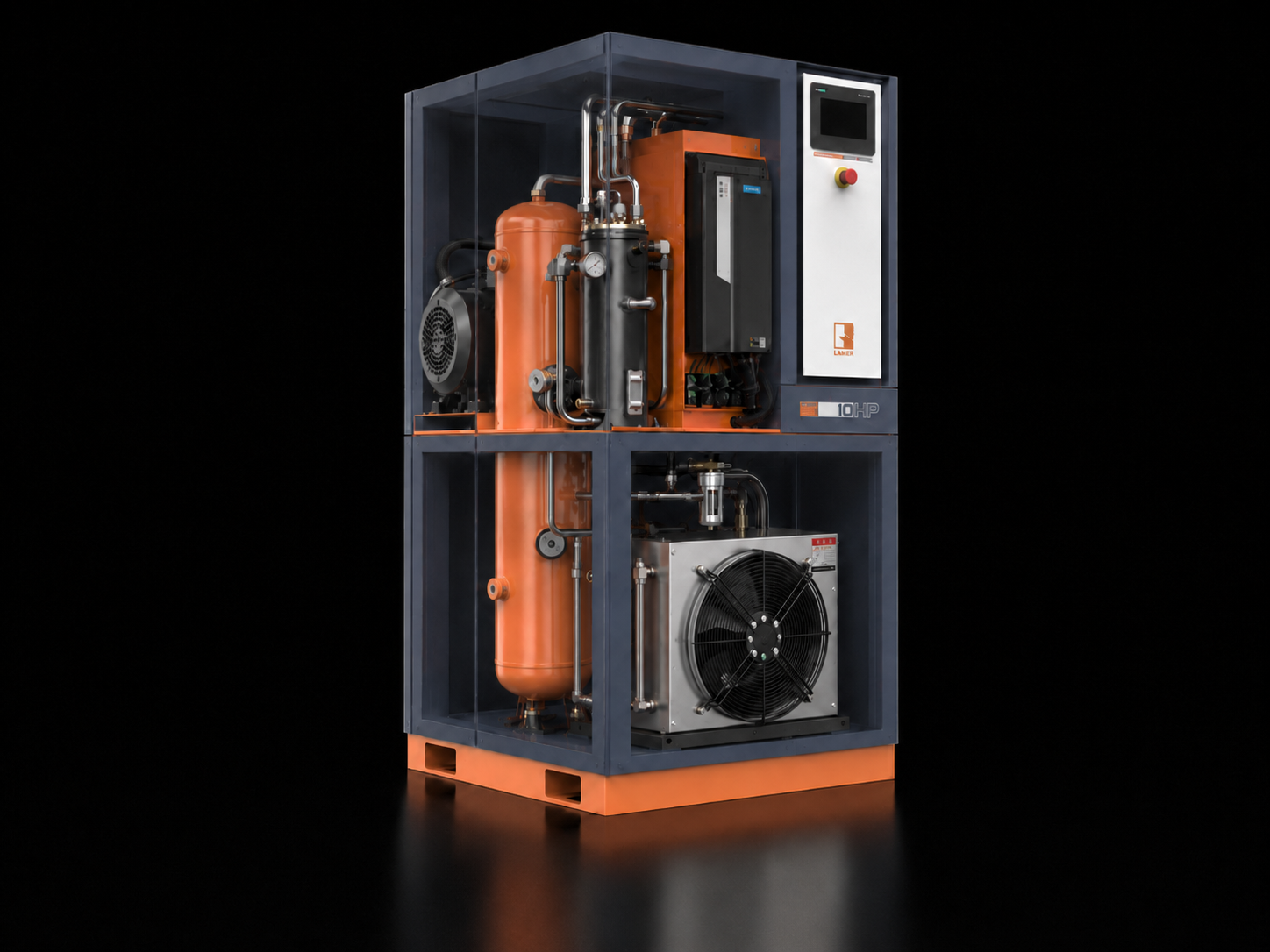
A compressor package alone does not guarantee line-ready air. The supplied application data lists matched equipment as an air dryer, air tank, line filter, inverter, and controller. Each item changes how the Micro compressor behaves in a plastics, packaging, or automation project.
- Air dryer: reduces moisture in the compressed-air stream. This matters in humid environments and in packaging or automation areas where moisture can affect valves, sensors, or product contact surfaces.
- Air tank: provides storage and buffering. The Micro series itself is listed with a 140 L gas tank, but the system may still need additional storage to stabilize pressure during demand peaks.
- Line filter: removes particles and other carryover before the air reaches the point of use. The required filtration level should be set by the application, not by a generic assumption.
- Inverter: is relevant where demand varies and a variable-speed or inverter-driven configuration is available. It should be confirmed for the selected model rather than assumed.
- Controller: coordinates operation and integration with the production line. The control requirement should be defined with the automation or packaging equipment supplier.
For continuous operation in high-temperature or humid environments, the air-treatment plan should be reviewed together with the compressor. A dryer or filter selected without reference to the actual duty cycle can create a false sense of security. The practical check is to define the air quality required at the point of use, then confirm that the dryer, tank, filter, and controller support that requirement.
Step-by-Step Selection Path for Plastics, Packaging, and Automation Projects
1. Define the air demand by project type
Start with the project, not the model. The supplied application profile identifies CNC machinery production lines, automotive parts production lines, plastic processing line expansions, industrial automation integration, and food and beverage packaging line setup projects. Each has a different demand pattern. A CNC line may need stable pressure for actuators and pneumatic tools; a packaging line may need clean air at multiple stations; an automation cell may need a controlled supply that matches machine cycles.
List the points of use, the required pressure at each point, and whether demand is steady or intermittent. The goal is to understand the load profile before choosing a 4 kW, 5.5 kW, or 7.5 kW package.
2. Match the power option to the load
Use the model mapping as the first screen: Micro ML-4A for 4 kW, Micro ML-5.5A for 5.5 kW, and Micro ML-7.5A for 7.5 kW. The mapping tells you which frame size to investigate; it does not by itself prove that the model will meet the required airflow at the required pressure. Ask for model-specific performance data at the working pressure and confirm the duty cycle.
3. Confirm pressure and storage
The Micro series is listed with an 8–13 bar pressure range and a 140 L gas tank. Confirm that the required line pressure sits within that range and that the tank volume is appropriate for the demand pattern. If the system has pressure peaks or a large number of intermittent actuators, additional storage may be needed. The tank should be treated as part of the system design, not as a substitute for correct compressor sizing.
4. Specify the air-treatment package
Select the air dryer, line filter, and any additional air tank according to the required air quality and the operating environment. The application profile includes high-temperature or humid environments, so moisture control deserves explicit attention. For food and packaging projects, confirm whether the application requires oil-free air; the supplied Micro series data does not state an oil-free configuration, so that requirement must be verified separately if it applies.
5. Plan the control and inverter interface
Define how the compressor will be controlled and how it will interact with the production line. The matched equipment list includes an inverter and a controller. If demand varies, ask whether an inverter or variable-speed option is available for the selected model. Do not assume that a VSD or permanent-magnet configuration is standard. A commercial research estimate places PM VSD savings at 20%–30% compared with traditional induction motors, but actual savings depend on the load profile and must be validated for the specific package.
6. Review continuous-operation requirements
The application profile describes continuous operation in high-temperature or humid environments with stable and clean compressed air. It lists energy saving, low noise, environmentally friendly operation, and high reliability as special requirements. These are selection criteria, not decorative claims. Ask how the package is protected in the intended environment, how noise is managed at the installation point, and what maintenance access is required for continuous duty.
7. Verify supply capability and quality control
UMW Air’s capability information lists OEM and ODM production, customization for color, logo, and voltage, a monthly capacity of 1,000 units, a 3-day lead time, a minimum order quantity of 1 unit, factory pre-shipment testing, and 24/7 technical support via email or phone. These details should be confirmed for the exact model and configuration in the quotation. A short lead time is useful, but it does not replace model-specific performance confirmation or air-treatment review.
Use Cases: Where the Micro Series Fits
CNC machinery production lines
CNC machinery production lines need stable compressed air for actuators, pneumatic tools, and dust removal systems. In a documented CNC machining workshop case in Vietnam, three units were used for these functions over a one-year period. The reported result was a 20% improvement in production efficiency, reduced downtime, and stable air supply for high-quality machining. The case also lists low energy consumption, easy maintenance, and reliable long-term performance as highlights. This is a single reported case; it should not be generalized to every CNC workshop without checking the local demand profile.
Plastic processing line expansions
A plastic processing line expansion often adds new points of use without adding a new central compressor room. The Micro series is listed for plastic processing line expansions and for plastics and rubber processing as an applicable industry. The project question is whether the new demand can be served with stable pressure and adequate air treatment. The 4–7.5 kW power range and 140 L tank provide a compact starting point, but the expansion should be assessed as a system: compressor, dryer, tank, filter, and controller.
Food and beverage packaging line setup
Food and beverage packaging line setup projects are included in the application profile. These projects require stable and clean compressed air, and the environment may be humid. The matched equipment list points to air drying and filtration as part of the package. If the application has a contamination-sensitive requirement, confirm whether oil-free air is required. The supplied Micro series data does not state an oil-free configuration, so this must be clarified before the equipment is specified.
Industrial automation integration
Industrial automation integration projects need a compressed-air supply that can be coordinated with the machine control system. The controller and inverter in the matched equipment list are relevant here. The automation integrator should define the pressure, flow, and control interface before the compressor model is fixed. The Micro ML-4A, ML-5.5A, and ML-7.5A give the project three power options to screen, but the final choice still depends on the demand calculation and the air-treatment design.
Automotive parts production lines
Automotive parts production lines are also listed in the application profile. These lines can combine pneumatic tools, actuators, and handling equipment in a continuous operation. The same selection logic applies: confirm pressure, airflow, storage, and air quality before choosing the power option. The Micro series is not presented as a plant-wide solution; it is a compact package for the project demand described in the application profile.
What to Verify Before Ordering a Micro Rotary Screw Air Compressor
The final specification should be checked against the project, not only against the catalog. Use the following checklist to keep the decision traceable.
- Model-specific airflow: confirm the delivered airflow at the required working pressure. The 1.1 m³/min figure is the series maximum in the supplied data.
- Pressure range: confirm the required line pressure is within the 8–13 bar range and that the control setpoint matches the application.
- Tank and storage: review the 140 L gas tank alongside the demand profile. Additional storage may be needed for peaks.
- Air end and construction: confirm the single-stage screw compressor air end and sheet metal construction for the selected model.
- Air treatment: specify the air dryer, line filter, and any additional tank needed for the required air quality.
- Control and inverter: confirm the controller interface and whether an inverter or variable-speed option is available.
- Environment: review high-temperature or humid conditions, ventilation, noise, and maintenance access for continuous operation.
- Certification and documentation: UMW Air’s published certification information lists ISO 9001:2015 and CE for Machinery/EMC Directives. Verify certificate scope, applicable model, and validity. If food or packaging air purity is critical, request the relevant air-quality evidence and confirm whether oil-free air is required.
- Supply terms: confirm OEM/ODM customization, MOQ, lead time, pre-shipment testing, and after-sales support for the exact configuration.
Frequently Asked Questions
What certifications should buyers check for a Micro rotary screw air compressor?
UMW Air’s published certification information lists ISO 9001:2015 and CE for Machinery/EMC Directives. Buyers should verify the certificate scope, the applicable model, and the validity date rather than relying on a general certification statement. For food, beverage, or packaging projects, also confirm the required compressed-air purity and whether an oil-free configuration is required; the supplied Micro series data does not state an oil-free configuration.
Which UMW Air Micro model matches a 4 kW, 5.5 kW, or 7.5 kW requirement?
The mapping is Micro ML-4A for 4 kW, Micro ML-5.5A for 5.5 kW, and Micro ML-7.5A for 7.5 kW. The supplied series data lists a maximum airflow of 1.1 m³/min, an 8–13 bar pressure range, a 140 L gas tank, a single-stage screw compressor air end, and sheet metal construction. Confirm the model-specific airflow at the required pressure before ordering.
What supporting equipment does a plastics, packaging, or automation project need?
The matched equipment list includes an air dryer, air tank, line filter, inverter, and controller. The dryer and filter support clean, dry air; the tank buffers demand; the inverter and controller support integration where a variable-speed or controlled operation is required. The exact specification should be set by the point-of-use air quality, the duty cycle, and the environment.
How does a rotary screw air compressor support CNC machine production lines?
In the supplied application profile, the compressor provides stable compressed air for CNC machinery production lines. A documented CNC machining workshop case in Vietnam used three units for CNC machine actuators, pneumatic tools, and dust removal systems over one year. The reported result was a 20% improvement in production efficiency, reduced downtime, and stable air supply. The case is a single reported example and should be checked against the actual demand profile of the project.
What supply details should be confirmed before placing an order?
Confirm the exact model, pressure, airflow, air-treatment package, and control configuration. UMW Air’s capability information lists OEM/ODM production, color/logo/voltage customization, MOQ of 1 unit, a 3-day lead time, monthly capacity of 1,000 units, factory pre-shipment testing, and 24/7 technical support via email or phone. Lead time and configuration should be confirmed in the quotation. To match a Micro model to a CNC, plastics, or packaging project, share the required pressure, airflow, duty cycle, and air-treatment needs with UMW Air through its official website.
Conclusion
The Micro ML-4A, ML-5.5A, and ML-7.5A give UMW Air a compact 4–7.5 kW rotary screw option for plastics and rubber processing, food and packaging, and industrial automation projects. The supplied series data supports the power mapping, the 1.1 m³/min series maximum airflow, the 8–13 bar pressure range, the 140 L gas tank, the single-stage screw air end, and sheet metal construction. Those facts are useful for early screening, but the project decision still depends on model-specific airflow at the required pressure, the air-treatment package, the control interface, and the continuous-operation requirements.
The safest selection path is to define the demand, match the power option, confirm pressure and storage, specify the dryer/filter/tank/controller/inverter package, and verify certification and supply details. That process keeps the compressor, the air-treatment system, and the production line aligned. Buyers who need to compare a Micro model against a specific CNC, plastic processing, packaging, or automation project can request the model-specific data and quotation through UMW Air.
Next step: Share your required pressure, airflow, duty cycle, and air-treatment needs with UMW Air to confirm the Micro ML-4A, ML-5.5A, or ML-7.5A configuration for your project.
Have Questions or Need More Details?
Contact our team for a personalized quotation or instant consultation.
Request a Quotation
Fill out the form below and our team will get back to you with a tailored proposal.
WhatsApp Direct Chat
Prefer to chat in real-time? Message us on WhatsApp for instant assistance & quick answers.
- Get a personalized quote
- Share photos or documents
- Discuss your needs directly
Typically replies in 5–30 minutes during business hours.