
Integrated vs Split vs Portable vs Fixed Screw Air Compressors: Configuration Comparison
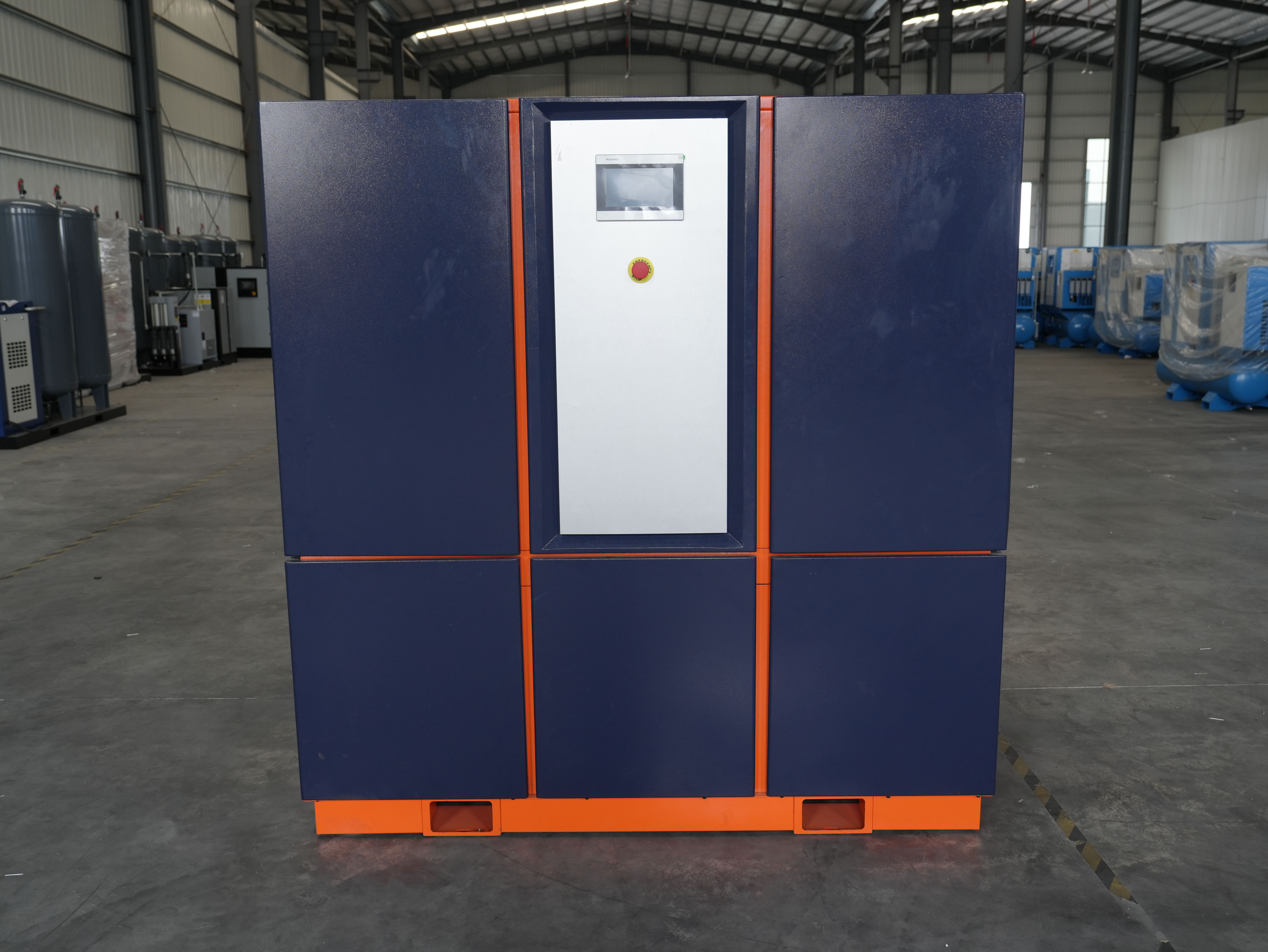
Short answer: integrated configurations suit constrained floor space and single-point installations; split configurations separate compression from air treatment so each can be sized and serviced on its own terms; portable configurations cover relocatable and off-grid site work; fixed configurations carry high-flow, continuous plant duty. All four use the same rotary screw compression principle. What changes is installed footprint and mobility, how the motor is matched to the airend, how heat is rejected, and how much of the compressed air treatment train travels with the machine.
This comparison is written for factory buyers at the decision stage, where the flow and pressure figures are already roughly known and the open question is packaging. It compares the four configurations against selection criteria that decide installed cost: installation footprint and mobility, direct-driven versus belt transmission, air-cooled versus water-cooled heat rejection, motor efficiency class, sheet-metal housing and service access, and continuous 24/7 duty. Specification examples are drawn from UMW Air listings — the L-2216A at 2.39 m³/min within an 8–25 bar working-pressure band on a 4–355 kW platform, and the Micro ML-4A, ML-5.5A and ML-7.5A at 4–7.5 kW with a 140 L tank — plus the supporting equipment every configuration still needs: air dryer, air tank, line filter, inverter and controller.
Why Configuration Comes Before Model Selection
Most compressed air projects begin with three numbers: required flow in m³/min, working pressure in bar, and available power in kW. Those numbers identify a machine, but they do not identify a system. Two offers with identical flow and pressure can differ by metres of pipework, a separate plant room, a foundation, a second power drop, a different maintenance routine and a different spare-parts holding.
Configuration is the variable that carries those differences. An integrated unit packages the compressor, aftercooler and — depending on scope — the dryer, receiver and filtration inside one canopy on one skid. A split system delivers compression as one package and air treatment as separate packages, connected on site. A portable unit is built to move. A fixed unit is built to stay. The compression end is a rotary screw airend in each case; the packaging is what the buyer actually installs.
Three practical consequences follow:
- Installed cost is not purchase price. Footprint, piping, foundation, power distribution and commissioning labour sit outside the machine price and move sharply between configurations.
- Air quality scope has an owner. If the required air purity class is not met, the fault can sit in the dryer, the filter, the receiver or the compressor — and in an integrated package all of them arrive together.
- Service access is a design decision, not an afterthought. Panels that must be removed to reach a filter element cost time on every service interval for the life of the machine.
The consequence of getting this wrong is rarely a machine that fails. It is a system that works while consuming floor space, maintenance hours and energy it did not need to consume.
Industry Background: Why Rotary Screw Dominates and Configuration Became the Differentiator
Grand View Research valued the global industrial air compressor market at USD 20.0 billion in 2025. Within that market, the rotary/screw segment held the largest product share at 47.0% in 2025, and Asia Pacific accounted for a revenue share of 42.8% in the same year. Oil-filled units represented 61.3% of the lubrication segment in 2026.
The reading for buyers is straightforward. Rotary screw compression is the mainstream industrial choice, so the technology decision is largely settled before a project reaches the quotation stage. What remains open — and what actually differentiates one project from the next — is how the screw compressor is packaged for the plant it serves.
Regulatory context sits alongside the technology context. In the United States, 10 CFR 431.342 defines a compressor as a machine or apparatus that converts different types of energy into the potential energy of gas pressure. Units manufactured starting 10 January 2025 must meet energy conservation standards, and manufacturers must follow DOE test procedure methods and certification requirements under 10 CFR 431.344, 10 CFR 431.345 and 10 CFR Part 429. Configuration does not change that obligation, but it does change which party supplies the equipment that has to satisfy it.
The Four Configurations Defined
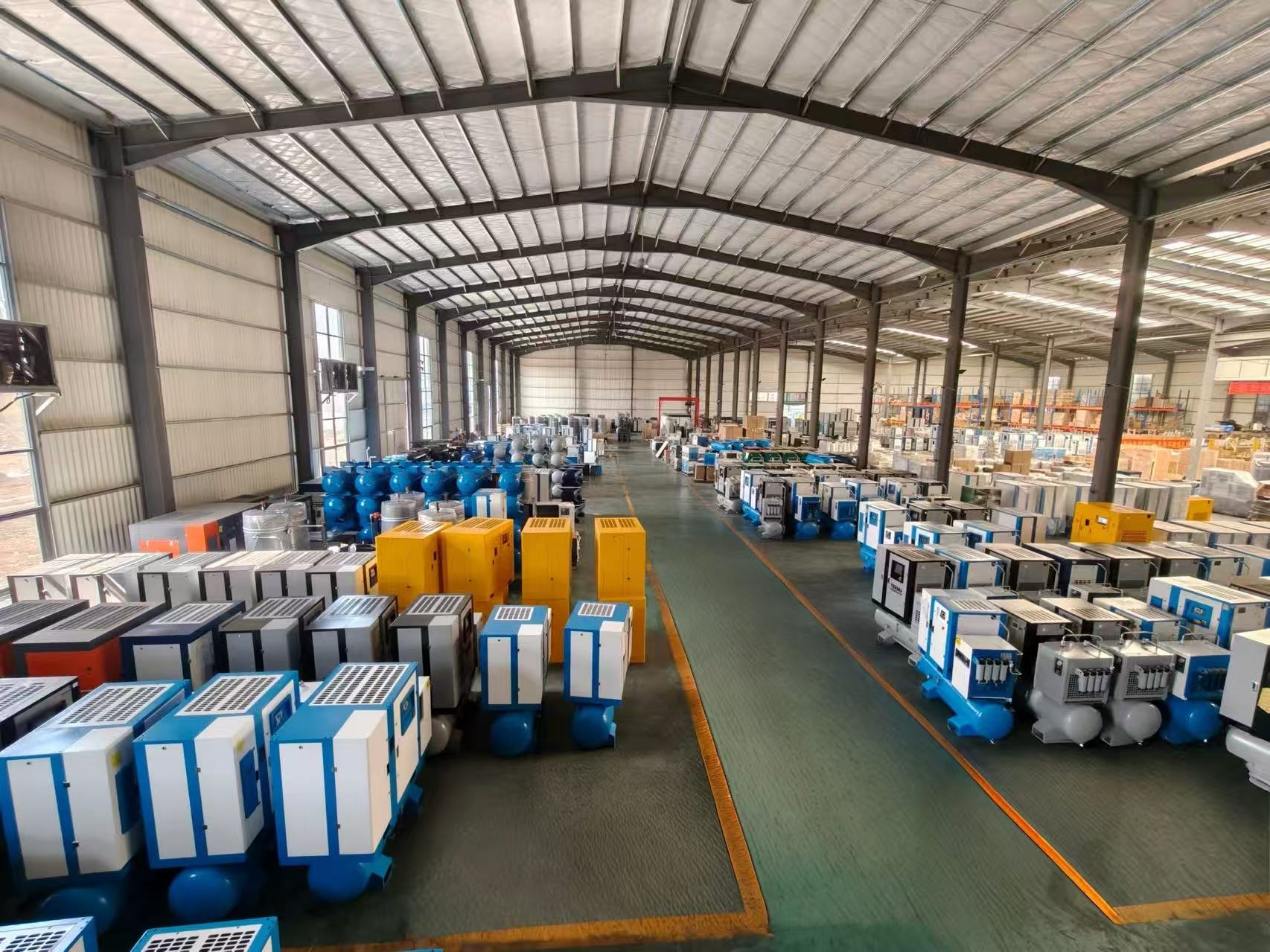
1. Integrated Screw Air Compressor (All-in-One Package)
An integrated air compressor places the compressor, motor, aftercooler and — in full-package versions — the air dryer, air tank and line filter inside a single sheet-metal canopy on one base frame. The buyer receives one unit, one power connection, one control interface and one footprint.
This configuration exists to remove coordination work. There is no separate dryer to plumb, no receiver to site, no argument about who supplies the filtration. The trade-offs are equally concrete: heat from the compression end and the dryer share one enclosure, so airflow and ambient temperature rating matter more than in a split installation; and every component inside the canopy must be reachable through the panels provided.
Compact variants sit at the small end of the same idea. The UMW Air Micro ML-4A, ML-5.5A and ML-7.5A cover 4–7.5 kW with a 140 L tank, packaging compression and storage in a single small frame for point-of-use duty.
2. Split / Separate-System Screw Air Compressor
A split configuration delivers the compressor as one package and treats the air dryer, air tank, line filter and controller as separate items connected by site pipework. Nothing is shared except the header.
The advantage is sizing freedom. Air treatment can be matched to the true duty — the actual flow, the actual pressure dew point, the actual purity class — instead of to whatever fits inside a canopy. Receiver volume can be increased independently. Each item can be serviced or replaced without opening the compressor enclosure. Components can be positioned where ambient conditions suit them, which matters in hot plants where a dryer placed beside a hot compressor block works harder than one placed in a cooler position.
The cost is installation scope: more pipework, more floor area, more connection points and more parties to coordinate during commissioning.
3. Portable and Diesel Mobile Screw Air Compressor
A portable screw compressor is built onto a chassis so it can be relocated — moved between bays, loaded onto a trailer, or run at a site with no fixed power. Diesel mobile screw compressors in this class serve work where the air demand moves with the job rather than staying in one place.
Portability is not a substitute for a plant air system. A mobile unit is not normally integrated with a fixed dryer, receiver and filtration train, and its duty pattern is driven by site activity rather than by a production schedule. For a factory with a stable, continuous air demand, a portable unit is a supplement or a temporary measure, not the base load machine.
4. Fixed / Stationary Screw Air Compressor
A fixed screw air compressor is anchored to a base and connected permanently to the plant distribution system. It is the configuration built for continuous duty, and it can be supplied air-cooled or water-cooled depending on how the plant rejects heat.
Fixed units carry the widest scope for supporting equipment, because everything downstream remains a separate, selectable decision: receiver volume, dryer type, filtration stages, inverter drive and multi-unit control. Where several units run in parallel, the controller becomes part of the configuration decision rather than an accessory.
Configuration Comparison Table
| Configuration | Footprint & mobility | Drive & cooling options | Air treatment scope | Where it fits |
|---|---|---|---|---|
| Integrated | Single skid, smallest installed footprint; stationary, not relocatable | Direct-driven airend; air-cooled package with radiator and cooling fan inside the canopy | Compressor, aftercooler and, in full packages, dryer, tank and line filter inside one enclosure | Constrained floor space; single-point installation; CNC cells; compact workshops |
| Split / separate | Two or more skids plus interconnecting pipework; larger installed footprint | Direct-driven; air-cooled or water-cooled compressor package selected independently of treatment | Dryer, tank, filter and controller sized and positioned separately, connected on site | Existing plant with a receiver and dryer in place; large flows; hot ambient positions |
| Portable / diesel mobile | Chassis-mounted and relocatable; no fixed foundation | Mobile screw package; suited to sites without a fixed power supply | Normally no fixed dryer, receiver or filtration train | Site work, temporary supply, moving demand across bays |
| Fixed / stationary | Anchored base; permanent position in the plant | Air-cooled or water-cooled; direct-driven or heavy-duty build for sustained load | Full downstream scope: receiver, dryer, filtration, inverter, multi-unit controller | Continuous 24/7 production; automotive parts; plastic processing lines |
Six Selection Criteria That Decide the Configuration
Criterion 1 — Installation Footprint and Mobility
Measure the space before comparing prices. An integrated package needs one clear area sized to the canopy plus service clearance on the panel side. A split system needs the compressor area plus space for the dryer, receiver and filtration, plus the pipework route between them.
Mobility is a separate question and should be answered honestly. If the air demand will move — between construction phases, between production bays, between sites — a portable configuration is the only one of the four designed for that. If the demand is fixed, mobility adds cost without returning value.
Criterion 2 — Direct-Driven Transmission
In a direct-driven screw air compressor, the motor is coupled directly to the airend. There are no belts to tension, retension or replace, and no belt slip to account for in the delivered flow. Belt-driven designs remain available and have their own service logic, but they introduce a wear item and a periodic adjustment into the maintenance calendar.
For a plant planning continuous duty over several years, transmission type is a maintenance-frequency decision rather than a performance preference. Ask which transmission the quoted model uses and what the service interval is for each option.
Criterion 3 — Air-Cooled Heat Rejection and Thermal Margin
An air-cooled screw air compressor rejects heat through a radiator and cooling fan. The configuration determines how hard that system has to work: inside an integrated canopy, the radiator is rejecting heat from the compression end and, in full packages, from the dryer as well, using air drawn through the same enclosure.
UMW Air controls overheating risk with a high-efficiency radiator and cooling fans, and performs thermal tests on every unit before shipment to confirm that radiators and fans are functioning properly. For the buyer, the transferable check is this: confirm the ambient temperature the package is rated for, confirm it against the actual plant condition, and confirm the airflow path around the installed unit will not be blocked by walls, ducting or stored material.
Criterion 4 — Motor Efficiency Class (IE4)
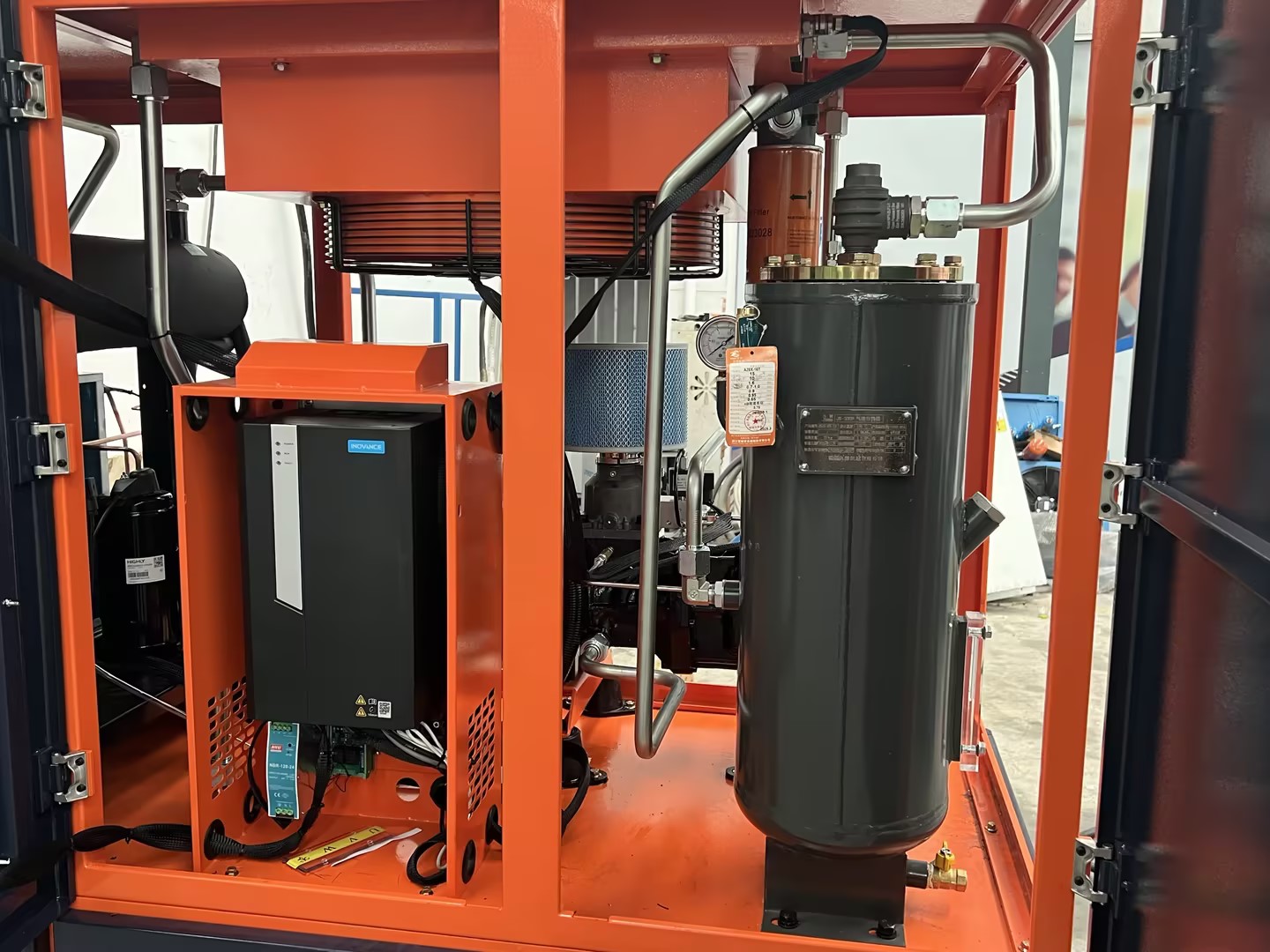
Motor efficiency is specified by class rather than by impression. IE4 is the efficiency class defined in IEC 60034-30-1, and it sits above the lower classes in the same framework. For a compressor running continuous shifts, the motor is the largest single conversion loss in the package, so the class is worth confirming in writing on the quotation.
The practical instruction is simple: ask which efficiency class the quoted drive motor carries, and ask for it as a line item. Where a supplier operates a variable frequency air compressor, confirm that the inverter is matched to the motor rather than added to a fixed-speed unit after the fact.
UMW Air states that it standardises PM VSD technology and low-resistance system design across its range, converting each kWh into productive output across the equipment lifecycle.
Criterion 5 — Sheet Metal Housing and Service Access
The housing is not cosmetic. It carries the airflow path, the acoustic treatment and the access points. On an integrated package, it also encloses the components that need the most frequent attention.
Check three things on the drawing or on a visit: which panels open, whether they are hinged or lift-off, and whether the filter, separator and oil-check points are reachable without dismantling ducting. Then check the airflow path — sound-attenuated housings trade airflow for quietness, and in a hot plant that trade can be the difference between a stable unit and a derated one.
Criterion 6 — Continuous 24/7 Operation
Screw air compressors are built for continuous duty and provide 24/7 operation capability, which makes them suitable for applications that require an uninterrupted air supply. Piston compressors, by comparison, are intermittent-duty machines.
Continuous duty is where configuration differences become measurable. Integrated packages concentrate heat and require the thermal margin to be demonstrated. Split systems allow the dryer and receiver to sit in cooler positions. Fixed heavy-duty builds and direct-driven transmission reduce the number of wear items in the service schedule. In every case, the question to ask is not whether the machine can run continuously, but whether the specific package has the thermal margin and service access to keep running continuously without unscheduled stops.
Supporting Equipment: What Each Configuration Already Includes
Every compressed air system needs five supporting functions regardless of configuration. The configuration decides whether those functions arrive inside the package, beside it, or on a separate order.
| Supporting equipment | Function | Integrated package | Split system |
|---|---|---|---|
| Air dryer | Removes moisture from the compressed air stream so the required pressure dew point is maintained | Often inside the canopy in full-package versions | Separate unit, sized to duty and positioned independently |
| Air tank / receiver | Stores compressed air, buffers demand peaks and stabilises pressure at the header | Compact receiver inside the frame (for example, the 140 L tank on the Micro ML series) | Separately sized receiver, volume selected to demand profile |
| Line filter | Removes particles and oil carry-over to meet the specified air purity class | Packaged filtration inside the canopy | Separate filtration stages on the discharge line |
| Inverter (VSD) | Varies compressor speed to match demand, avoiding fixed-speed load/unload cycling | Specified as part of the package specification | Selected with the compressor, matched to the motor |
| Controller | Manages sequencing, pressure bands and alarms; coordinates multiple units | Single integrated control interface | Separate controller, able to sequence several compressors |
Air purity targets themselves are defined rather than negotiated. ISO 8573-1:2010 sets compressed air quality classes covering particles, water and oil. Where a process requires a specific class, the class should appear on the specification and should determine the dryer and filter selection — which in turn affects whether an integrated package or a split layout can meet it. Where the process requires oil-free air, the compressor type offered must be confirmed against the class rather than assumed.
Worked Specification Examples: L-2216A and the Micro ML Series
Concrete numbers make the configuration decision testable. UMW Air lists the L-2216A at 2.39 m³/min, inside a working-pressure band of 8–25 bar, with the wider platform spanning 4–355 kW. At the other end of the range, the Micro ML-4A, ML-5.5A and ML-7.5A cover 4–7.5 kW with a 140 L tank.
Read together, these two examples show how configuration follows flow. A unit delivering 2.39 m³/min at up to 25 bar sits in plant-level duty: it needs a receiver and dryer sized to its discharge, and the choice between packaging that treatment inside a canopy or placing it beside the machine is a floor-space and service-access decision. A 4–7.5 kW unit with a 140 L tank sits at point-of-use duty: it serves a single machine or a single bay, and an integrated package with storage included removes the need to site a separate receiver at all.
Buyer rule: select the configuration from the required flow and duty cycle, then confirm the model's delivered displacement at the actual working pressure. Displacement quoted at one pressure does not transfer unchanged to another, and the pressure band — 8–25 bar in this example — is a range the platform covers, not a single rating.
Application Fit: CNC, Automotive Parts and Plastic Processing
CNC Machinery
CNC machine tools draw air at the point of use, at relatively small flow, and are sensitive to pressure fluctuation. An air compressor for CNC machine duty is usually a point-of-use decision: a compact integrated package placed near the cell shortens the pipe run, reduces pressure drop and keeps the receiver close to the load. Where several CNC cells share a header, a fixed unit with a sequencing controller is the more practical base-load choice.
Automotive Parts Manufacturing
Automotive parts production spreads air demand across many stations — clamping, handling, testing, blow-off — and runs to a production schedule rather than to individual machine cycles. That profile favours a fixed configuration with a separately sized receiver and dryer, so peak demand is buffered at the header and treatment capacity is matched to the true duty rather than to a canopy dimension.
Plastic Processing Lines
Plastic processing is continuous, and the line does not stop for a compressor service. Continuous 24/7 operation is the defining requirement, which pushes the decision toward fixed or heavy-duty builds with direct-driven transmission, verified thermal margin, and service access that allows maintenance to be planned inside a shutdown window. Where ambient temperature in the plant is high, the thermal margin question in Criterion 3 becomes the deciding one.
Step-by-Step Configuration Selection Workflow
- Fix the demand. Establish required flow in m³/min at the actual working pressure, plus the pressure band the process can tolerate.
- Map the duty cycle. Continuous 24/7 production and intermittent point-of-use demand lead to different configurations.
- Measure the available space. Record the footprint available, the service clearance and the airflow path before comparing packages.
- Confirm mobility honestly. If the demand will relocate, portable is the only configuration built for it; if not, exclude it.
- Decide the air-treatment owner. Choose whether the dryer, tank and filter are packaged inside the canopy or specified separately, and record the required air purity class from ISO 8573-1:2010.
- Verify heat rejection. Confirm the ambient rating of the package against the installed position, and confirm radiator and fan access.
- Confirm transmission and motor class. Record direct-driven or belt-driven, and the motor efficiency class (IE4 under IEC 60034-30-1) as a written line item.
- Inspect the housing. Check panel access to filters, separators and inspection points, and check that acoustic treatment does not block the airflow path.
- Compare quotes on identical scope. Include dryer, receiver, filtration, inverter, controller, piping and commissioning in every quote before comparing totals.
Where UMW Air Fits in This Comparison
UMW Air (Shandong UMW Air Tech Co., Ltd) is a manufacturer of screw air compressors based on Gongye South Road, Jinan, Shandong, China, exporting to the EU, USA, Southeast Asia, the Middle East, South America and Africa. The company was founded in 2019 and operates a 2,000 m² facility with 200 employees, a 40-person R&D team and an annual output of 12,000 units.
Its listed product line includes air-cooled screw air compressors, direct-driven screw air compressors, stationary screw air compressors, heavy-duty screw air compressors and diesel mobile screw air compressors, covering 4–355 kW and 8–25 bar. That spread is relevant to this comparison because it spans three of the four configurations discussed here — integrated-style compact packages at the small end, stationary and heavy-duty builds for continuous plant duty, and diesel mobile units for site work. Buyers comparing configurations can use the criteria above to interrogate a single supplier's range rather than reconcile four vendors' packaging conventions.
FAQ
What compliance requirements should be settled before a screw compressor configuration is chosen?
In the United States, 10 CFR 431.342 defines a compressor, and units manufactured starting 10 January 2025 must meet energy conservation standards, with manufacturers following DOE test procedure methods and certification requirements under 10 CFR 431.344, 10 CFR 431.345 and 10 CFR Part 429. On air quality, ISO 8573-1:2010 defines compressed air purity classes for particles, water and oil — and that class determines whether a dryer and line filter are in scope. Configuration does not change the compliance obligation, but it changes which equipment is supplied by which party, so the class and the certification position should be confirmed in writing before the package is fixed.
Can one supplier deliver more than one of these configurations?
UMW Air's listed range covers air-cooled screw air compressors, direct-driven screw air compressors, stationary screw air compressors, heavy-duty screw air compressors and diesel mobile screw air compressors, from 4 to 355 kW and 8 to 25 bar. A single-source range matters because a split configuration requires the compressor and the separately supplied treatment equipment to be matched on flow, pressure dew point and control logic. Buyers should still confirm configuration-specific scope — what is inside the canopy and what is not — in writing on the quotation.
Is an integrated configuration cheaper than a split system?
Purchase price and installed cost are different figures and should be compared separately. An integrated package carries less installation scope: one skid, one power connection, one control interface and no site pipework between compression and treatment. A split system spreads the cost across more items but allows treatment capacity to be sized to actual duty and serviced or replaced independently. Across the compressor itself, screw technology carries a slightly higher initial investment than piston types, but lower downtime and maintenance costs follow from fewer moving parts and longer service intervals, giving a higher long-term return. The rule that holds for configuration comparison is to put dryer, receiver, filtration, inverter, controller, piping and commissioning into every quote before comparing totals.
How can a buyer validate a configuration before committing to a full production line?
Request three things: documented displacement at the actual working pressure rather than at a single catalogue point, a factory test record for the specific unit, and a reference installation of the same configuration in a comparable ambient environment. UMW Air performs thermal tests on every unit before shipment, checking that radiators and cooling fans are functioning properly — a test record of that kind is directly relevant to an integrated package, where heat from compression and drying share one enclosure. For multi-unit projects, ask for one unit to be built and witnessed before the remaining units are released.
How should lead time be planned for a multi-unit compressed air project?
Sequence the order around the critical path. Air treatment and the receiver usually need to be on site before piping and civil works are closed out, while the compressors themselves are positioned last. UMW Air operates a 2,000 m² facility with an annual output of 12,000 units and a 40-person R&D team, and exports 100% of production, so delivery planning should account for export documentation and freight alongside manufacturing time. Include spare filters and confirm commissioning support in the same discussion. To plan a specific project, contact the UMW Air team at info@umwair.com or +86 15053148082 with the required flow, pressure band, duty cycle and preferred configuration.
Conclusion: Choose the Configuration, Then the Model
Integrated, split, portable and fixed screw air compressors are not four technologies. They are four packaging decisions applied to the same rotary screw compression principle, and they diverge on the variables that determine installed cost: footprint and mobility, transmission type, heat rejection, motor efficiency class, housing and service access, and whether the machine is built for continuous 24/7 operation.
The sequence that avoids expensive rework is consistent. Fix the demand and the duty cycle, measure the space, decide who owns the air treatment, verify thermal margin against the real ambient, confirm transmission and motor class in writing, then compare quotes on identical scope. A configuration chosen this way is defensible on the drawing board, at commissioning and across the service life of the plant.
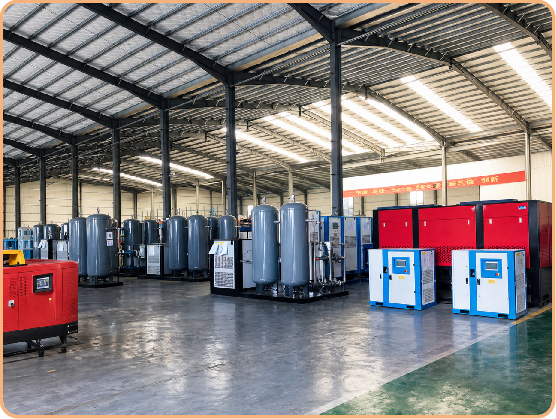
Next step: send UMW Air your required flow (m³/min), working pressure (bar), duty cycle and available footprint, and request a configuration-matched quotation that lists the air dryer, air tank, line filter, inverter and controller as separate scope lines.
Website: umwair.com | Email: info@umwair.com | Phone / WhatsApp: +86 15053148082 | Address: 68 Gongye South Road, Jinan, Shandong, China, 250000
Have Questions or Need More Details?
Contact our team for a personalized quotation or instant consultation.
Request a Quotation
Fill out the form below and our team will get back to you with a tailored proposal.
WhatsApp Direct Chat
Prefer to chat in real-time? Message us on WhatsApp for instant assistance & quick answers.
- Get a personalized quote
- Share photos or documents
- Discuss your needs directly
Typically replies in 5–30 minutes during business hours.