
Integrated vs. Split Screw Air Compressor: A Head-to-Head Decision Guide
An integrated screw air compressor and a split arrangement perform the same compression work; they differ in where the system boundary sits. That one difference controls floor-space use, installation scope, how the air dryer, receiver, line filter, inverter and controller are planned, and how easily the machine is serviced. On the UMW Air platform the point is explicit: the L-2216A is quoted at 2.39 m³/min at 8–25 bar working pressure, the platform spans 4–355 kW with IE4 motor efficiency, and the same machine family is offered as integrated, split/separate, portable and fixed types. Because rated capability travels with the platform rather than the enclosure, the decision should rest on installation and operating fit, not on an assumed performance hierarchy.
UMW Air (Shandong UMW Air Tech Co., Ltd, umwair.com) is a manufacturer of industrial screw air compressors based in Jinan, China, exporting 100% of its output to the EU, USA, Southeast Asia, Middle East, South America and Africa. This guide sets out the variables that genuinely separate the two configurations, tests them against continuous 24/7 duty in four production environments, and closes with a pre-order question set for specification review.
The Decision in One Paragraph
Choose the integrated configuration when the compressor, dryer, receiver, line filter, inverter and controller should be planned, installed and supported as one packaged system — typically when floor space is constrained, the installation window is short, and one supplier should own the whole system boundary. Choose the split/separate arrangement when those items are better selected, placed and serviced individually — typically when an existing receiver or dryer is being reused, when the plant layout spreads equipment across rooms or roof areas, or when component-level isolation and replacement matter more than a single footprint. Neither route changes the quoted output: the L-2216A is specified at the same 2.39 m³/min and 8–25 bar whether the machine is packaged or separated. The real comparison is installation scope, air-quality planning, service access and duty behaviour.
What Each Configuration Actually Contains
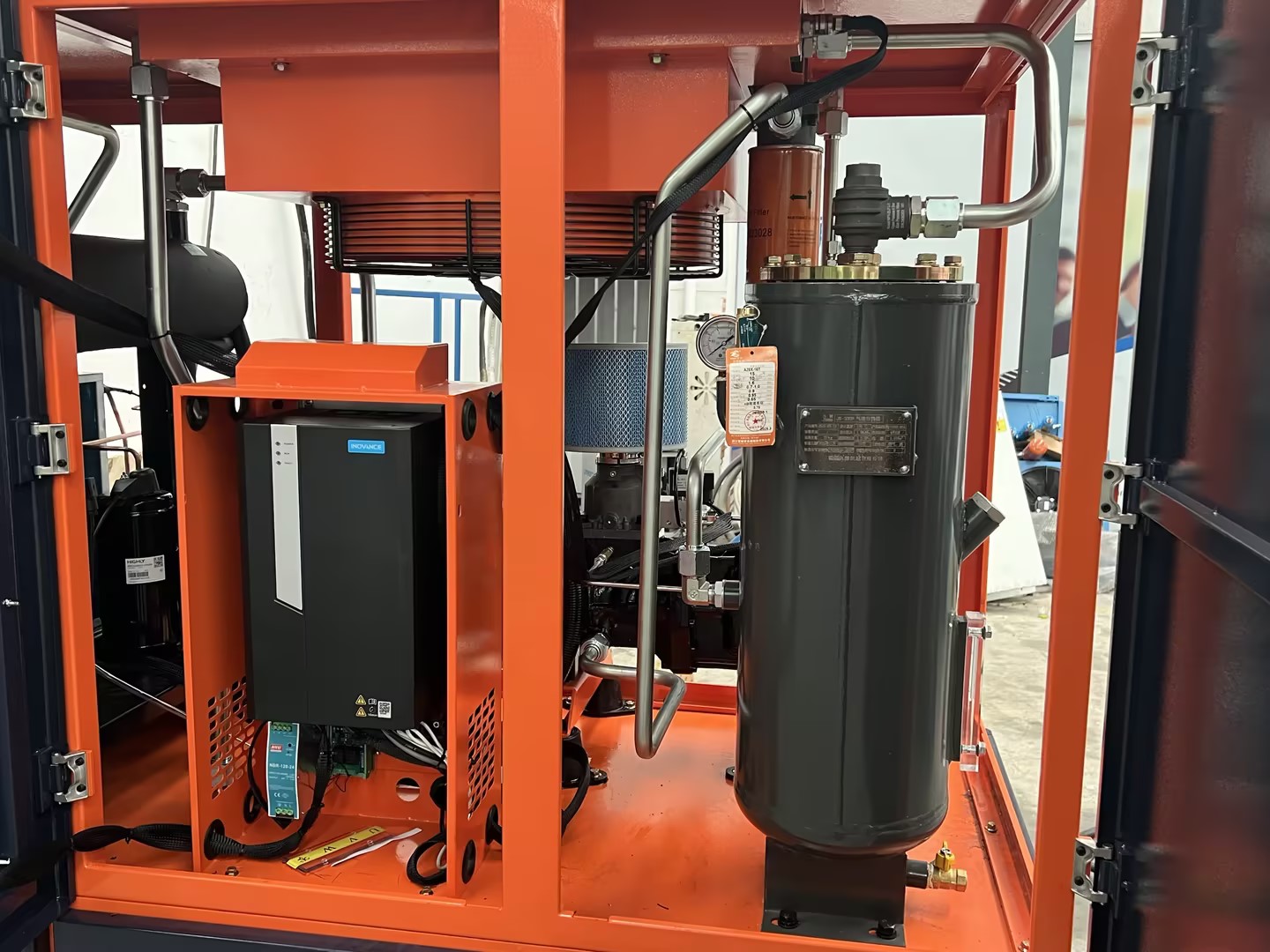
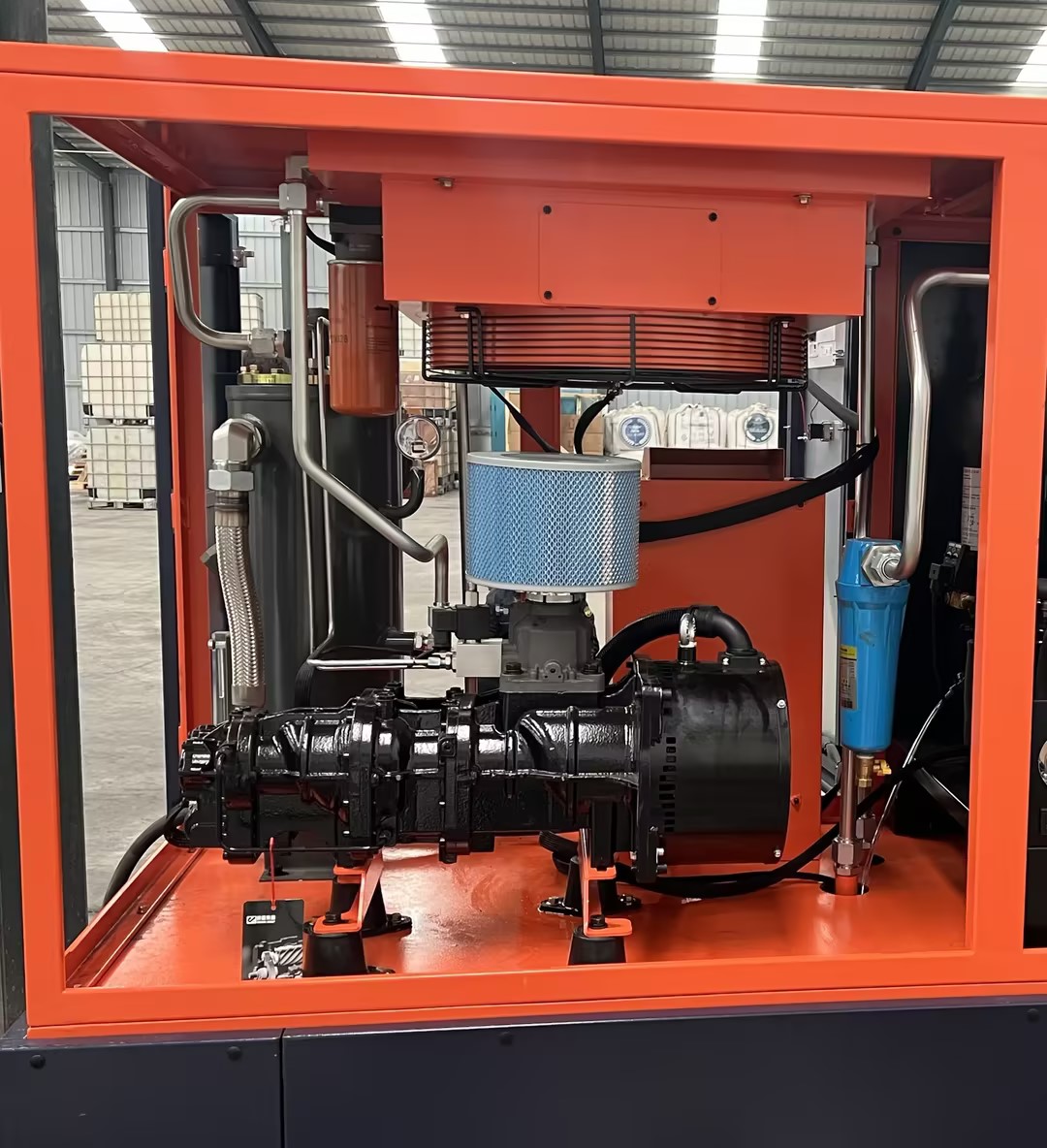
An integrated screw air compressor is a single packaged unit: direct-driven, air-cooled, built into a sheet-metal housing, with its auxiliaries planned inside the package scope. Direct drive means the motor drives the air end directly rather than through a belt transmission, and air cooling means heat is rejected to the room through a radiator and cooling fans. Because the package is one assembly, the buyer purchases and positions one item rather than a set of them.
A split or separate arrangement treats the compressor as one machine and the dryer, air receiver, line filter, inverter (where specified) and controller as separate items. Each is selected, positioned and connected individually, with interconnecting piping, electrical feeds and drains forming part of the installation scope. The compression principle does not change: a split system is still a rotary screw compressor, and separation does not make it more or less capable.
The frequent mistake is to read “integrated” as a smaller or lighter-duty class of machine. On this platform that reading fails: power spans 4–355 kW and working pressure spans 8–25 bar, and the same family is offered in integrated, split/separate, portable and fixed types. Integrated and split are packaging terms, not performance tiers. That is why the comparison below is organised around installation and operating variables rather than around output.
Why the Configuration Question Now Sits Inside the Technology
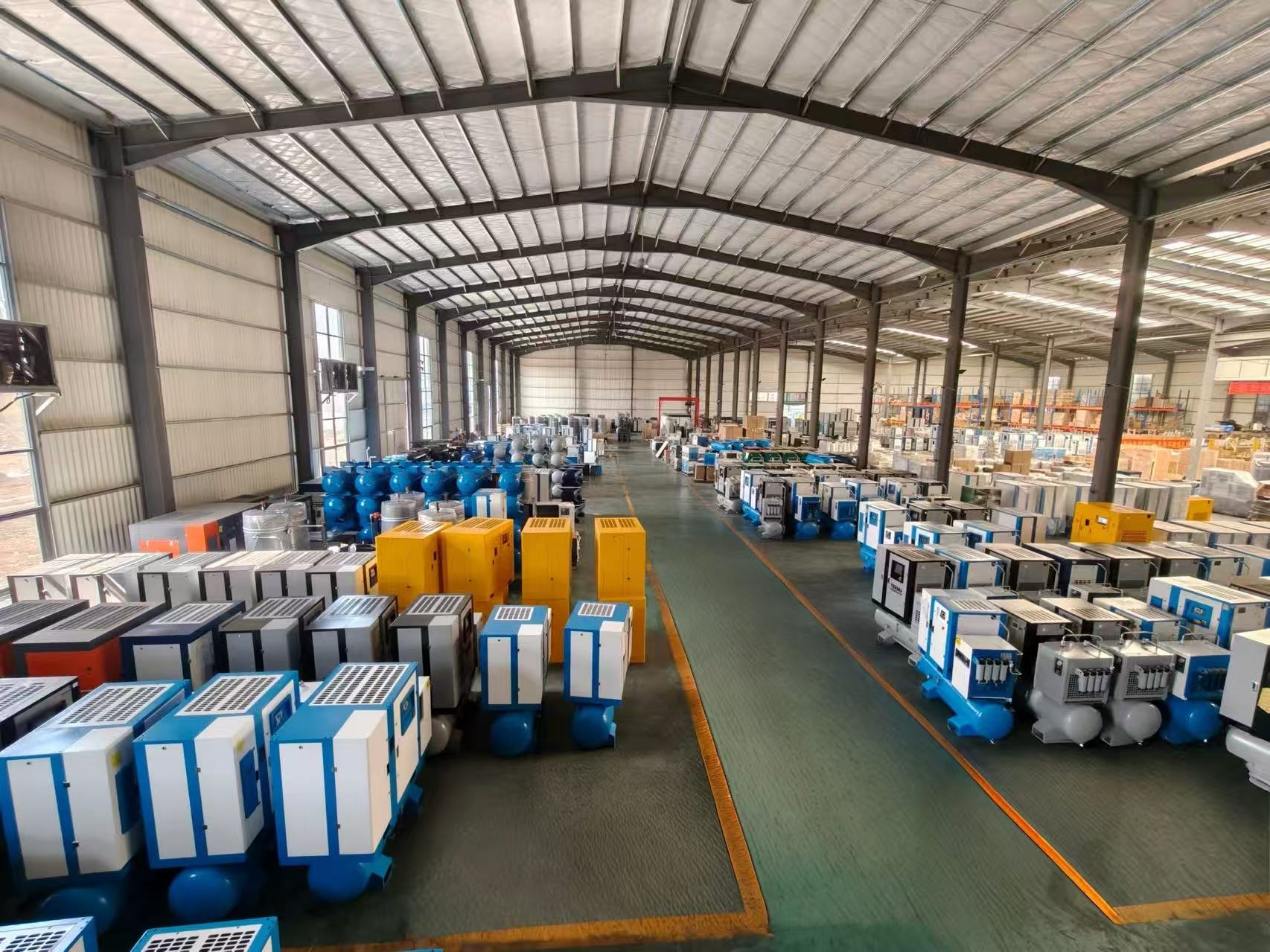
Rotary screw technology is the dominant choice in industrial compressed air, which pushes buyer comparisons inside the technology rather than between technologies. The global industrial air compressor market was valued at USD 20.0 billion in 2025, and the rotary/screw segment held the largest product share at 47.0% in the same year; Asia Pacific accounted for a 42.8% revenue share in 2025 (Grand View Research, Industrial Air Compressor Market Size Report, 2026–2033). When almost half of the installed base is screw technology, the practical purchasing question stops being “screw or something else” and becomes “how should the screw system be packaged, controlled and serviced”.
Two further axes are often confused with configuration. Lubrication is one: oil-filled machines represented 61.3% of the lubrication segment in 2026, according to the same source, and that choice is independent of whether the unit is packaged or separated. Air quality is the other: ISO 8573-1:2010 defines compressed air quality classes, and the required class — not the housing — determines what the dryer and line filter must achieve.
Compliance obligations follow the model and the destination market, not the enclosure. In the United States, 10 CFR 431.342 defines a compressor for regulatory purposes, and units manufactured on or after 10 January 2025 must meet the applicable energy conservation standards while manufacturers follow the established test procedure, certification, compliance and enforcement requirements under 10 CFR Part 429 (U.S. Department of Energy). Supplier screening can start from industry classification — NAICS 333912 covers establishments manufacturing general purpose air and gas compressors — but classification tells you what a company makes, not whether a specific configuration suits your plant.
Decision Variable 1: Floor Space and Installation Scope
The integrated unit consumes one contiguous footprint that already includes its auxiliaries, and it arrives as one assembly, so site work concentrates on positioning, connecting and commissioning. In practical terms that usually means a single power feed, a single condensate drain point, one air outlet and one defined ventilation path, with fewer trades and fewer interfaces to coordinate. The constraint runs the other way: the full footprint, plus panel-opening clearance and airflow clearance, must be available at once, and the delivery route — door widths, lifting points, headroom, floor loading — has to be checked before the order, not on the delivery day.
A split arrangement distributes that footprint. The compressor can sit in a plant room, the receiver outdoors or in a corner, the dryer wherever space and drainage allow, and each item can be isolated and replaced without moving the rest. The trade-off is scope: interconnecting piping, separate electrical feeds, additional drains and coordinated controls all become installation work, and someone must own pressure drop across the added pipework and the sequence of commissioning steps.
For either route, ask for dimension drawings that show service clearance, the ventilation requirement and a scope-of-supply list stating who supplies piping, valves, drains and electrical work. A quotation without those three items cannot be compared with another quotation.
Decision Variable 2: One System or Several for Dryer, Receiver, Filter, Inverter and Controller
In an integrated package these items are planned as one system at the quotation stage: the dryer is matched to the compressor flow, the filter to the required air-quality class, the receiver to demand fluctuation, and the controller is designed to run the package. The benefit is coherence — sizing decisions are made together by one party. The corresponding risk is visibility: an undersized dryer or a filter grade below the required class is harder to spot inside a closed package, so the quotation must name the included components and state the air-quality class in ISO 8573-1 terms.
In a split arrangement each item is specified and procured on its own terms. That allows a larger receiver for fluctuating demand, a dryer upsized for future load, or replacement of a single failed component without touching the compressor. The cost is interface ownership: dew point, pressure drop and control coordination sit between suppliers, or between the buyer and each supplier, and a fault can be attributed in more than one direction.
Two specifications should never be left to the packaging decision. First, air quality: state the ISO 8573-1 class explicitly, because that class drives dryer type and filter grade in both configurations. Where a process requires a lubricant-free machine, treat it as a separate specification and confirm it against the offered model rather than assuming it from the housing. Second, the drive: where a variable-frequency drive is specified, confirm whether it sits inside the package controller or in a separate panel, and who configures the control strategy and set points.
Decision Variable 3: Maintenance Access and Heat Rejection in Continuous Duty
Screw air compressors require low maintenance because they have fewer moving parts and longer service intervals than traditional piston compressors, and they provide 24/7 operating capability for applications that need continuous air supply. Those properties belong to the screw platform, not to the enclosure: an integrated unit and a split unit on the same platform carry the same maintenance philosophy. What the configuration changes is how easily a technician reaches the work.
On an integrated unit, access is through removable sheet-metal panels. Ask for panel-opening dimensions, the clearance needed to reach the air filter, oil filter and separator, and the distance from the panel to the radiator face. On a split system, components are individually accessible, but there is more walk-around: more connections, more drains and more inspection points spread across the plant. A distributed layout can quietly turn a routine service into a route through two rooms.
Heat is the constraint that most often decides the layout. Air-cooled machines reject heat to room air through a high-efficiency radiator and cooling fans, and UMW Air performs thermal tests on every unit before shipment to confirm that radiators and fans function correctly. That test record verifies the machine; it does not verify the room. An integrated package concentrates heat rejection at a single point, which is efficient to ventilate but unforgiving if the space is tight. Separated components spread the heat load, which can help in an awkward plant room but complicates the ventilation calculation. Either way, confirm the rejected-heat figure and the required air path from the drawings instead of assuming the existing ventilation is sufficient.
Integrated vs. Split: Comparison on the Variables That Differ
| Decision dimension | Integrated screw air compressor | Split / separate arrangement |
|---|---|---|
| Scope of supply | One packaged unit in a sheet-metal housing, direct-driven and air-cooled, with auxiliaries planned inside the package | Compressor as one machine, plus dryer, receiver, line filter, inverter and controller as separately specified items |
| Footprint | One contiguous footprint including auxiliaries; clearance needed for panel opening and airflow | Distributed footprint; each item placed where space, drainage and ventilation allow |
| Installation work | Fewer interfaces: one power feed, one drain point, one outlet, one ventilation path | More interfaces: interconnecting piping, separate electrical feeds, additional drains, coordinated commissioning |
| Dryer, receiver, filter | Sized and quoted together; must be named on the quotation with the air-quality class | Selected individually; allows larger receiver, upsized dryer, or reuse of existing equipment |
| Inverter and controller | Package controller runs the system; confirm drive location and control strategy | Drive and controls may be separate panels; control coordination must be assigned |
| Heat rejection | Concentrated at one point; ventilation path must match the rejected-heat figure | Spread across components; ventilation calculation covers several positions |
| Service access | Through removable panels; verify panel opening and radiator clearance | Direct access to each component, but a longer route and more connections to inspect |
| Continuous 24/7 duty | Screw platform provides 24/7 capability; low maintenance with long service intervals | Same platform and same duty capability; maintenance plan follows the distributed layout |
| Rated capability | Identical on the stated platform: L-2216A quoted at 2.39 m³/min, 8–25 bar; platform range 4–355 kW with IE4 motor efficiency | |
| Typical fit | Tight floor space, short installation window, single-owner system boundary | Existing receiver or dryer in service, distributed plant layout, component-level replacement priority |
The table compares documented characteristics and scope. It does not establish that either configuration delivers better efficiency, reliability or air quality at the point of use, because those outcomes depend on sizing, installation quality and the maintenance regime rather than on the enclosure.
Continuous 24/7 Duty in Four Production Environments
Metal processing
Metal shops typically run CNC machines, laser cutting equipment and press or clamping operations from a shared air system, and the air often reaches precision pneumatics and optical equipment. Where that is the case, the decision pivots on clean, dry air at the point of use: state the ISO 8573-1 class and then place the dryer and filter accordingly. An integrated package suits a compact cell with limited floor space and a short installation window; a split layout suits a central plant room feeding distributed drops, where a larger receiver can absorb demand spikes across several machines. Metalworking environments also carry dust and scale, so radiator and filter access should be checked on the drawings before the layout is fixed.
Plastics
Injection moulding, blow moulding and resin conveying draw air for clamping, ejection, conveying and blow-off, usually across multiple shifts with fluctuating demand. Fluctuating demand is a receiver and control question first: in a split arrangement the receiver can be sized independently and placed where space allows, while an integrated package keeps the receiver, dryer and controls within one envelope that must still be large enough for the demand profile. Because plastics lines often run continuously, the maintenance interval and the access route matter more than the housing style.
Automotive parts
Automotive parts production combines pneumatic tools, clamping fixtures, test stands and instrumentation, distributed over a large floor area and frequently operated around the clock. Distributed demand generally favours a central system with a properly sized receiver and a defined air-quality class, and the configuration decision then turns on plant-room space and service access rather than on machine capability. Where air contacts painted surfaces, gauges or instruments, the filtration and drying scope must be specified by class, not inferred from the compressor package.
Food packaging
Food packaging lines often operate in wet or washdown conditions, and air may come into contact with packaging or product. Here the decision should start from the required air-quality class and from where the dryer and receiver can physically sit without being exposed to washdown. A split arrangement allows the dryer and receiver to be located in a drier, more accessible area while the compressor stays near the line; an integrated package keeps everything together but requires that the enclosure and its placement suit the environment. Verify declared enclosure protection and materials with the supplier rather than assuming them from a product photograph.
Step-by-Step: Running the Decision Before You Request a Quote
- Fix the demand point. Record required flow, working-pressure band, duty cycle and the number of simultaneous users. On this platform the L-2216A is quoted at 2.39 m³/min and 8–25 bar, with platform power spanning 4–355 kW.
- Fix the air-quality class. State it in ISO 8573-1 terms so the dryer and line filter scope is defined before configuration is discussed.
- Fix the drive and control scope. Decide fixed-speed or variable-frequency operation, confirm the IE4 motor efficiency class on the offered model, and define who configures set points and monitoring.
- Map the physical envelope. Measure footprint, headroom, panel-opening clearance, ventilation path, drainage and the delivery route.
- Draw the system boundary. List which items sit inside the package and which stay separate, and record who supplies piping, valves, drains and electrical work.
- Check maintenance access. Confirm filter, separator and radiator access, and whether isolation valves allow service without shutting the whole plant.
- Check the heat path. Match the room ventilation to the rejected-heat figure for the chosen configuration and ambient conditions.
- Normalise the quotations. Compare only quotes with identical flow, pressure, air-quality class and control scope, itemised by component.
- Agree acceptance and delivery. Define pre-shipment acceptance inspection, documentation, packing, shipping marks and spares before the order is placed.
When Each Configuration Wins the Decision
Integrated tends to fit when
- Floor space is limited and a single contiguous footprint is easier to allocate than several positions.
- The installation window is short and the site wants fewer trades and fewer interfaces.
- One supplier should own the whole system boundary, including the dryer, receiver, filter and controls.
- Air quality, receiver volume and control strategy can be fixed at the quotation stage without conflict with existing equipment.
- The ventilation path can be dedicated to a single heat-rejection point.
Split tends to fit when
- A correctly sized receiver or dryer already exists and can be reused.
- The plant layout spreads equipment across rooms, roof areas or separate buildings.
- Component-level replacement and isolation are priorities for the maintenance team.
- Capacity is being added in phases, with individual items upgraded at different times.
- Heat or vibration is better distributed than concentrated at one position.
Boundary check: if the site already has a correctly sized receiver and dryer, an integrated package may duplicate equipment you are paying for. If the site has no plant-room space at all, a split layout does not automatically solve the problem — the receiver and dryer still need positions, drainage and ventilation. Decide the layout before choosing the enclosure.
Pre-Order Question Set for Specification Review
Use these questions to convert the decision into a comparable, verifiable order. They also frame the purchasing terms and the pre-shipment acceptance inspection that UMW Air agrees with the buyer before dispatch.
- Which configuration is quoted — integrated or split/separate — and what exactly is inside the scope of supply?
- What flow and pressure are stated for the quoted model, and how do they relate to the platform range of 4–355 kW and 8–25 bar?
- Is the motor quoted at IE4 efficiency class, and is the drive fixed-speed or variable-frequency?
- Which dryer, receiver and line filter are included, and what ISO 8573-1 air-quality class do they deliver together?
- What footprint, weight and panel-opening clearance apply, and what delivery route is required?
- What heat is rejected to the room, and what ventilation does the installation require?
- How are the air filter, oil filter, separator and radiator reached for service, and which isolation valves are supplied?
- Which documentation accompanies the unit: dimension drawings, scope list, control description, test records?
- What does the pre-shipment acceptance inspection cover, and does it include the thermal test record confirming radiator and cooling-fan function?
- What packing, shipping marks and spares are included, and what lead time applies to this configuration?
- Which purchasing terms apply to this order, and what are the payment and documentation milestones?
- Who is the technical contact for drawing approval, and who handles commissioning support?
For specification review of a specific configuration, contact the UMW Air team directly:
Phone: +86 15053148082
Email: info@umwair.com
WhatsApp: +86 15053148082
Address: 68 Gongye South Road, Jinan, Shandong, China, 250000
Website:umwair.com
Frequently Asked Questions
Does the integrated or split configuration change which standards or compliance documents apply?
No — configuration is not the regulated product characteristic. Applicable requirements follow the compressor model, its ratings and the market where it is placed. Air quality is stated through ISO 8573-1:2010 classes, so the dryer and filter specification follows the class rather than the housing. For the United States, 10 CFR 431.342 defines a compressor for regulatory purposes, and units manufactured on or after 10 January 2025 must meet the applicable energy conservation standards while manufacturers follow the DOE test procedure, certification, compliance and enforcement requirements. Ask for the documents that apply to your exact model and destination.
Can the same UMW Air model be delivered as either integrated or split?
On the stated platform, yes. The L-2216A is quoted at 2.39 m³/min at 8–25 bar, the platform covers 4–355 kW with IE4 motor efficiency, and the same machine family is offered as integrated, split/separate, portable and fixed types. Confirm the exact configuration and scope of supply on the quotation, because the dryer, receiver, line filter, inverter and controller may sit inside or outside the package depending on the order.
Is an integrated configuration cheaper to install and own than a split system?
This comparison does not claim a cost ranking, because comparable published price data for the two configurations is not part of it. What can be said is where the money moves: separate items add interconnecting piping, separate electrical work, additional footprint and interface management, while an integrated package concentrates those elements into one supply. At technology level, screw compressors carry a slightly higher initial investment than traditional piston machines but deliver lower long-term cost through reduced downtime and maintenance. To compare fairly, require itemised quotes with identical capacity, pressure, air-quality class and control scope.
What documentation should be requested before placing the order?
Request dimension and clearance drawings, a scope-of-supply list, the air-quality class stated in ISO 8573-1 terms, controller and drive details including whether the drive is fixed-speed or variable-frequency, the motor efficiency class, the rejected-heat figure with ventilation requirements, a maintenance-access description, and test records. UMW Air performs thermal tests on every unit before shipment to confirm that radiators and cooling fans function correctly, so ask for that record to be included with the pre-shipment acceptance inspection.
How are lead time and pre-shipment acceptance inspection handled?
Lead time depends on the chosen configuration and scope, so it is set on the order and confirmed within the purchasing terms rather than assumed from a catalogue. Pre-shipment acceptance inspection is the stage where the agreed configuration, documentation and test records are verified before dispatch: confirm the inspection checklist, whether the buyer or its representative attends, the packing specification and the shipping marks at order stage. The specification-review contacts listed in this guide can confirm both the lead time and the acceptance arrangements for your configuration.
Conclusion: Decide the System Boundary, Then the Enclosure
Integrated and split screw air compressors are two ways of drawing the same system boundary, offered here from one platform: L-2216A at 2.39 m³/min and 8–25 bar, platform power from 4–355 kW with IE4 motor efficiency, available as integrated, split/separate, portable and fixed types. The enclosure does not raise the output, and separation does not improve it. What changes is floor space and installation scope, whether the dryer, receiver, line filter, inverter and controller are planned as one system or several, how a technician reaches the machine, and how heat and ventilation are handled in continuous 24/7 duty.
Work the decision in order: fix flow, pressure band and air-quality class; map footprint, clearance and the delivery route; draw the scope boundary and assign interface responsibility; then compare itemised quotations on identical scope. Send the completed pre-order question set to the UMW Air specification-review team so that the configuration, documentation and pre-shipment acceptance points are confirmed before the order is placed.
Have Questions or Need More Details?
Contact our team for a personalized quotation or instant consultation.
Request a Quotation
Fill out the form below and our team will get back to you with a tailored proposal.
WhatsApp Direct Chat
Prefer to chat in real-time? Message us on WhatsApp for instant assistance & quick answers.
- Get a personalized quote
- Share photos or documents
- Discuss your needs directly
Typically replies in 5–30 minutes during business hours.