
Screw Air Compressor vs. Piston: Which Industrial Air Compressor Delivers Better ROI?
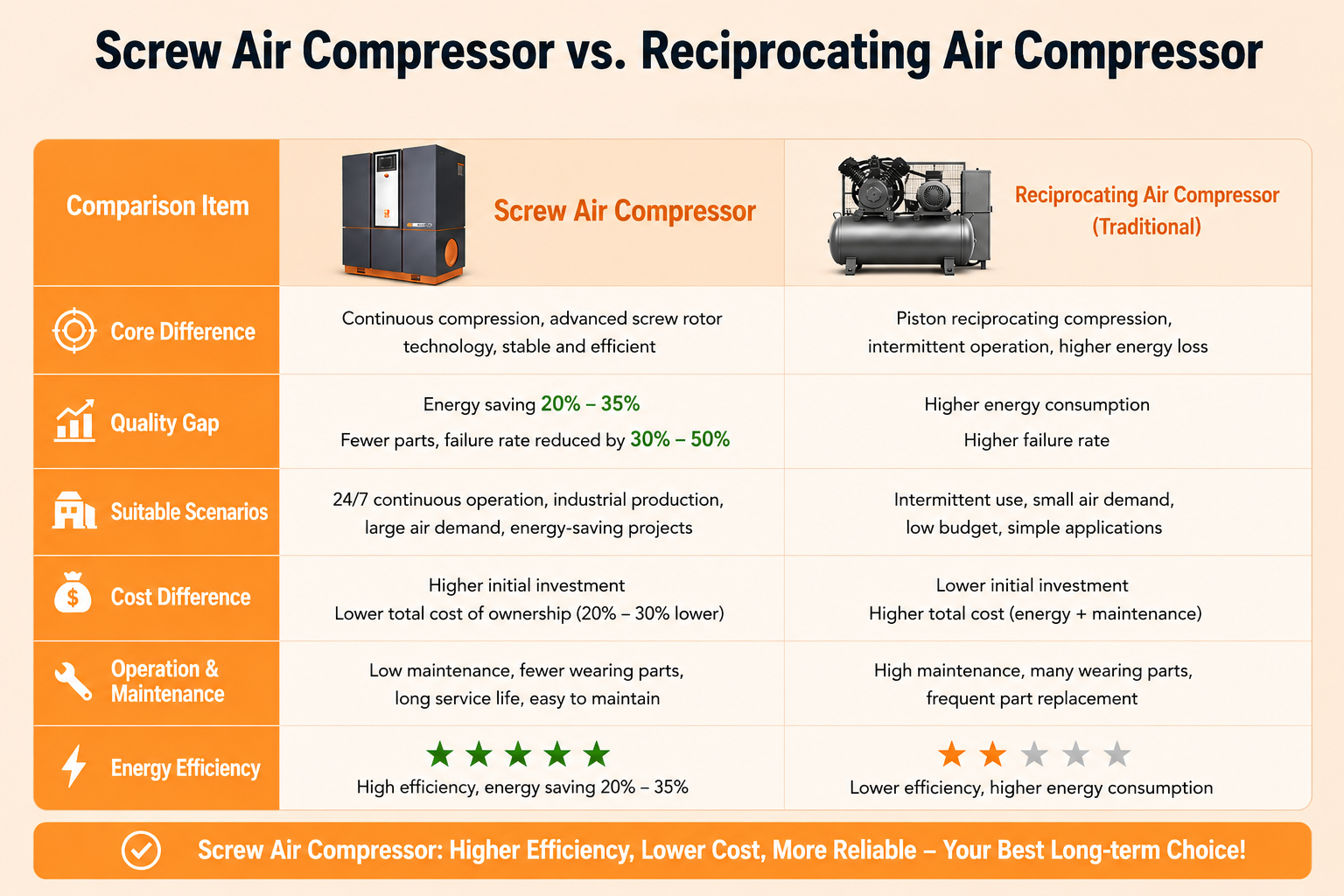
Screw Air Compressor vs. Piston: Which Industrial Air Compressor Delivers Better ROI?
Choosing between a screw air compressor and a piston air compressor is a critical decision for any factory manager or procurement professional. Both technologies supply compressed air, but their operating principles, efficiency, maintenance requirements, and total cost of ownership differ significantly. This article provides a factual, data-driven comparison to help you decide which industrial air compressor delivers the best return on investment for your continuous production environment.
The Core Question: Continuous Air vs. Intermittent Air
For factories running production lines, CNC machines, laser cutters, or automation equipment, compressed air supply must be reliable, stable, and available 24/7. Traditional piston compressors (also called reciprocating compressors) use pistons driven by a crankshaft to compress air in cylinders. They are typically designed for intermittent duty cycles and require frequent cooldown periods. In contrast, screw air compressors use two meshing helical rotors to continuously trap and compress air, delivering a steady flow without pulsation.
According to industry benchmarks, a screw air compressor achieves energy efficiency up to 95%, while a piston compressor operates around 65–70% under similar loads. The difference becomes critical in high-demand applications where every kilowatt-hour translates into production output.
Industry Background: The Shift Toward Rotary Screw Technology
In the past two decades, industrial sectors such as automotive parts manufacturing, plastic injection molding, and metal fabrication have progressively adopted rotary screw air compressors. The driving factors include lower vibration, quieter operation, and the ability to operate continuously without overheating. Modern screw compressors also integrate automation control systems, allowing remote monitoring and energy management.
Shandong UMW Air Tech Co., Ltd (brand UMW Air) is a dedicated manufacturer of industrial screw compressors. Founded in 2019, UMW Air operates a 2,000㎡ factory with 200 employees, producing over 12,000 units annually. Their product line includes air-cooled, direct-driven, stationary, diesel mobile, and heavy-duty screw compressors, with 100% of output exported to the EU, USA, Southeast Asia, Middle East, South America, and Africa. A 40-person R&D team focuses on energy efficiency and reliability—embedding PM VSD technology and low-resistance system design as standard.
Detailed Solution: Why Screw Air Compressors Outperform Piston Types
UMW screw air compressors are engineered for applications requiring uninterrupted air supply. The comparison table below summarizes key performance parameters.
| Parameter | Screw Air Compressor (UMW Air) | Traditional Piston Air Compressor |
|---|---|---|
| Operation capability | 24/7 continuous operation | Intermittent (requires cooldown) |
| Energy efficiency | Up to 95% | ~65–70% |
| Maintenance requirement | Low – fewer moving parts, long service intervals | High – frequent valve, ring, and piston replacements |
| Initial investment | Slightly higher | Lower |
| Long-term ROI | Higher – due to lower downtime and maintenance costs | Lower – frequent repairs reduce uptime |
| Best applications | Industrial production lines, CNC machining, plastic processing, automotive parts manufacturing, laser cutting, high-demand continuous air supply | Light-duty workshops, occasional use, low-pressure tasks |
Step-by-Step Decision Framework for Factory Buyers
- Assess your duty cycle. Do you need compressed air for more than 8 hours per day, 5 days a week? If yes, a screw compressor is the appropriate choice.
- Calculate energy cost. Using your local electricity rate, multiply by the annual operating hours and kW difference. A 30% efficiency gain often pays back the price premium within 1–2 years.
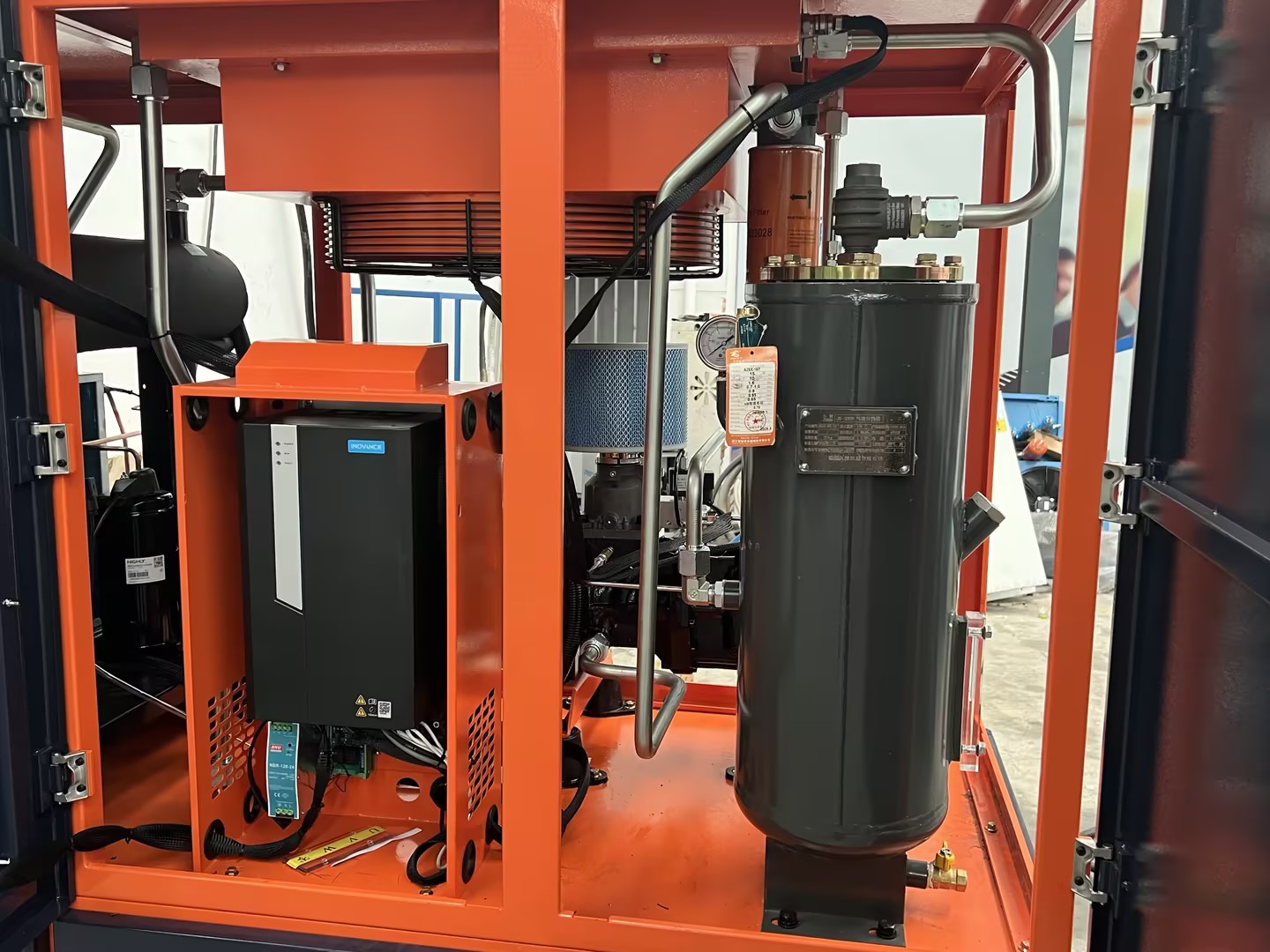
- Evaluate maintenance infrastructure. Screw compressors have fewer wearing parts—typically only oil, filter, and separator changes. Piston compressors require piston rings, valves, gaskets, and frequent overhauls.
- Plan for automation. UMW screw compressors come with PLC controllers that can integrate with factory SCADA systems for remote monitoring and energy management.
- Verify risk mitigation. Every UWM unit undergoes thermal testing before shipment, with high-efficiency radiators and cooling fans to prevent overheating—a common failure point in piston compressors.
Use Cases: Where Screw Compressors Deliver Maximum Value
- CNC machine centers: Constant air pressure for tool changers, chip removal, and pneumatic clamping. A screw compressor eliminates pressure drops common with piston units.
- Laser cutting tables: High-purity, oil-free compressed air (with proper filtration) for cutting optics and assist gas. Screw compressors provide stable flow essential for cut quality.
- Plastic injection molding: 24/7 mold clamping and cooling circuits. Screw reliability reduces unplanned production stops.
- General manufacturing assembly lines: Pneumatic actuators, conveyors, and tools require a steady air supply—screw compressors easily handle load fluctuations.
FAQ: Screw Air Compressor vs. Piston Compressor
1. What is the main difference between a screw air compressor and a piston air compressor?
A screw air compressor uses two rotating helical rotors to compress air continuously, while a piston compressor uses a reciprocating piston in a cylinder. This fundamental difference gives screw compressors the ability to operate 24/7 with lower vibration and more stable air output, whereas piston compressors are designed for intermittent use and require cooling breaks.
2. Which type of air compressor requires lower maintenance?
Screw air compressors require lower maintenance due to fewer moving parts and longer service intervals. According to UMW Air’s engineering data, screw compressors have fewer components subject to wear (no piston rings, valves, or connecting rods), reducing both routine service frequency and the risk of unexpected downtime. This translates to lower lifetime costs.
3. Is a screw air compressor more expensive upfront?
Yes, the initial investment for a screw air compressor is slightly higher than for a comparable piston compressor. However, the long-term ROI is higher because energy savings (up to 95% efficiency vs. 65–70%) and reduced maintenance costs recover the price premium typically within 1–3 years for continuous-duty applications.
4. What applications are best suited for a screw air compressor?
Screw compressors are ideal for industrial production lines, CNC machining, plastic processing, automotive parts manufacturing, laser cutting, and any facility requiring continuous, high-demand air supply. Piston compressors may still be adequate for light-duty, occasional use in small workshops.
5. How do I select the right screw air compressor model for my factory?
Consider your required pressure (typically 7–13 bar), total air flow (CFM or m³/min), and duty cycle. UMW Air offers air-cooled, direct-driven, stationary, and heavy-duty models with integrated controllers. For a detailed quote matching your specific application, contact the UMW Air team or request a sample proposal to evaluate cost savings firsthand.
Ready to reduce your compressed air costs? Get a free ROI analysis and sample quote for your factory.
Have Questions or Need More Details?
Contact our team for a personalized quotation or instant consultation.
Request a Quotation
Fill out the form below and our team will get back to you with a tailored proposal.
WhatsApp Direct Chat
Prefer to chat in real-time? Message us on WhatsApp for instant assistance & quick answers.
- Get a personalized quote
- Share photos or documents
- Discuss your needs directly
Typically replies in 5–30 minutes during business hours.