
Rotary Screw Air Compressor Supplier Vetting: Capacity, Lead Time, and Delivery Assurance
Rotary Screw Air Compressor Supplier Vetting: Capacity, Lead Time, and Delivery Assurance
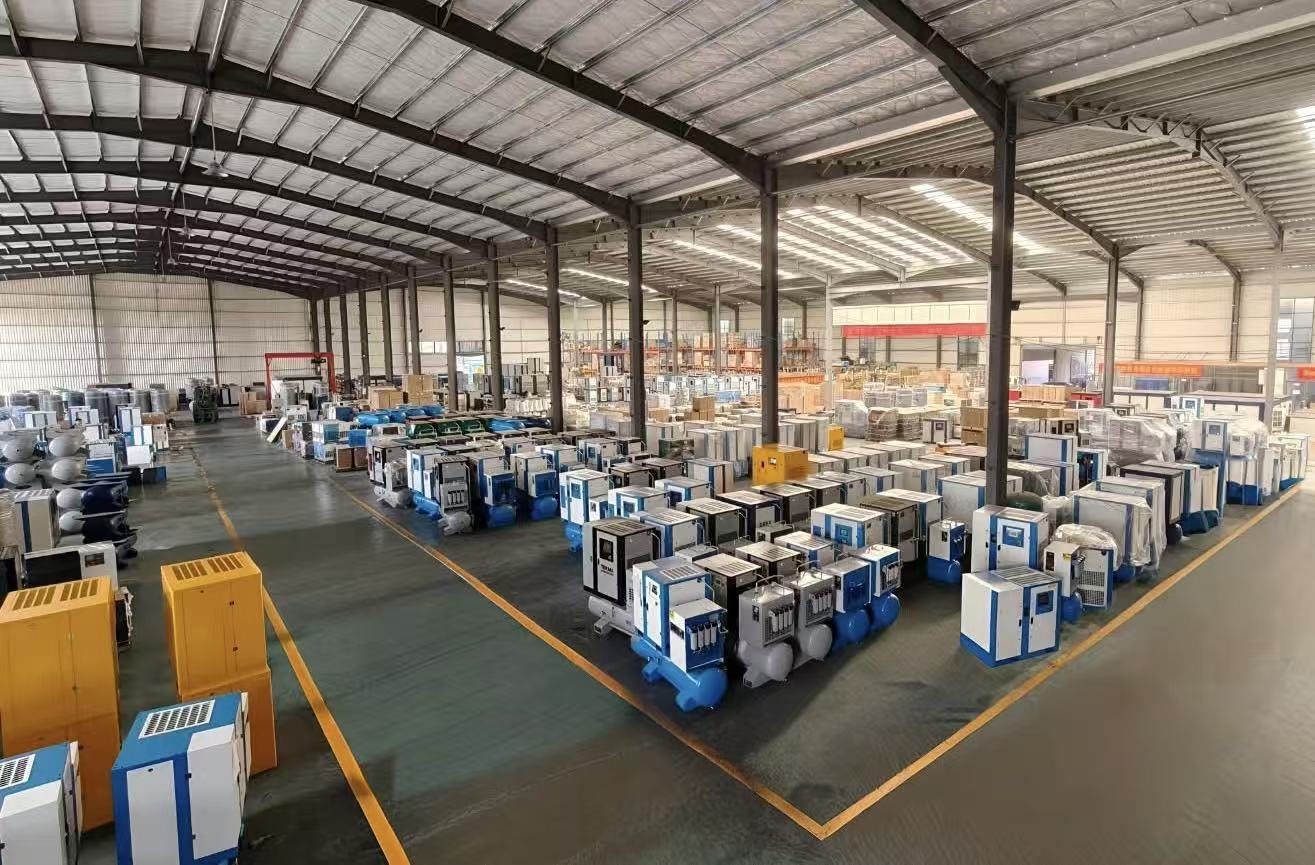
Delivery assurance is the one part of rotary screw air compressor sourcing that a specification sheet never covers. Pressure, airflow, motor efficiency, and control type describe a machine; they say nothing about whether the supplier can build, test, and dispatch that machine on the date written into the purchase order. For a plant that runs compressed air continuously — a CNC shop, a laser cutting cell, a food and beverage packaging line — a late compressor is not a procurement inconvenience. It is a stopped production line.
This article is a vetting checklist for that gap. It works through five verification points that can be checked against evidence rather than adjectives: production capacity, lead time, minimum order quantity, factory pre-shipment testing, and technical support. Shandong UMW Air Tech Co., Ltd. (UMW Air) — a rotary screw air compressor manufacturer established in 2019, operating a 2,000 m² manufacturing facility in Jinan, Shandong, China — is used as a worked example, because a vetting checklist only has value when a supplier's claims can be compared against specific, checkable numbers.
Problem Definition: Delivery Risk Never Appears on a Quotation
A standard rotary screw air compressor quotation lists power, pressure range, airflow, cooling method, drive method, and price. It rarely states plant capacity, current order backlog, order-level minimum order quantity, or the testing protocol applied before dispatch. Buyers therefore compare suppliers on the variables that are easiest to publish, while the variables that actually determine delivery performance stay unexamined.
Three patterns account for most delivery failures in industrial equipment sourcing. In the first, the supplier is an intermediary without reserved production slots, so the promised date depends on a third party's schedule. In the second, the supplier is a genuine manufacturer but its capacity is committed to larger accounts, and smaller orders move to the back of the queue. In the third, the first shipment performs and the second slips, because the original order was accommodated rather than scheduled.
None of these patterns is visible in a quotation, and all three are addressable before the purchase order is issued. That is the case for running supplier vetting on capacity and scheduling evidence instead of on price comparison alone — particularly when the compressor will run continuously and a single unplanned stop cascades through downstream production.
Industry Background: What Market Structure Tells a Buyer to Verify
Compressed air is now a globally sourced category, and that changes what a buyer should check. The reference points below come from published market research and international standards.
| Reference point | Published figure | Source |
|---|---|---|
| Global rotary screw compressor market | USD 12.5 billion (2024), projected to reach USD 13.3 billion (2025) | Custom Market Insights |
| Scope comparison across research houses | USD 5.1 billion (screw-only) vs USD 12.8 billion (screw segment) vs USD 18.04 billion (total air compressor market) | Custom Market Insights / Persistence Market Research / Fortune Business Insights |
| Stationary rotary screw share of technology | Approximately 67.6% (2025) | MarketsandMarkets |
| Asia Pacific regional share | 43.7% (2025), with China as the leading country in the region | Grand View Research |
| Oil-filled share of the lubrication segment | 61.7% (2025); oil-free types growing at a faster CAGR of 5.4% | Grand View Research / MarketsandMarkets |
| Named market participants | Atlas Copco AB, Ingersoll Rand Inc., Kaeser Compressors, Sullair LLC | Custom Market Insights |
| Compressed air purity standard | ISO 8573-1:2010 — purity classes for particles, water, and oil | ISO |
Two practical readings follow. First, market-size figures differ mainly by scope: screw-only, screw-segment, and total air compressor market are three different measurements of the same industry, and the spread between USD 5.1 billion and USD 18.04 billion reflects definition rather than disagreement about direction. A buyer building a business case should confirm which scope a number describes before using it in a capital request.
Second, stationary rotary screw units account for roughly two-thirds of technology share. For most buyers, the production capacity that matters is therefore stationary-unit capacity, not mobile, diesel, or specialty capacity — so a supplier's headline capacity number should be checked against the share of that capacity allocated to the unit type actually being purchased.
Geography adds a third reading. Asia Pacific holds the largest regional share of rotary air compressor demand, with China as the leading country in that region, which means a substantial share of global rotary screw air compressor supply is manufactured in China and exported worldwide. Supplier vetting, not country selection, is the decisive variable. The named market participants — Atlas Copco AB, Ingersoll Rand Inc., Kaeser Compressors, and Sullair LLC — represent the top tier of the market; below them sits a large group of mid-sized export manufacturers whose delivery performance is determined by plant capacity and scheduling discipline rather than brand recognition.
Detailed Solution: Five Verification Points, Checked Against Evidence
Each point below converts a vague supplier promise into a question with a checkable answer.
1. Production Capacity: Measure in Units per Year, Not Adjectives
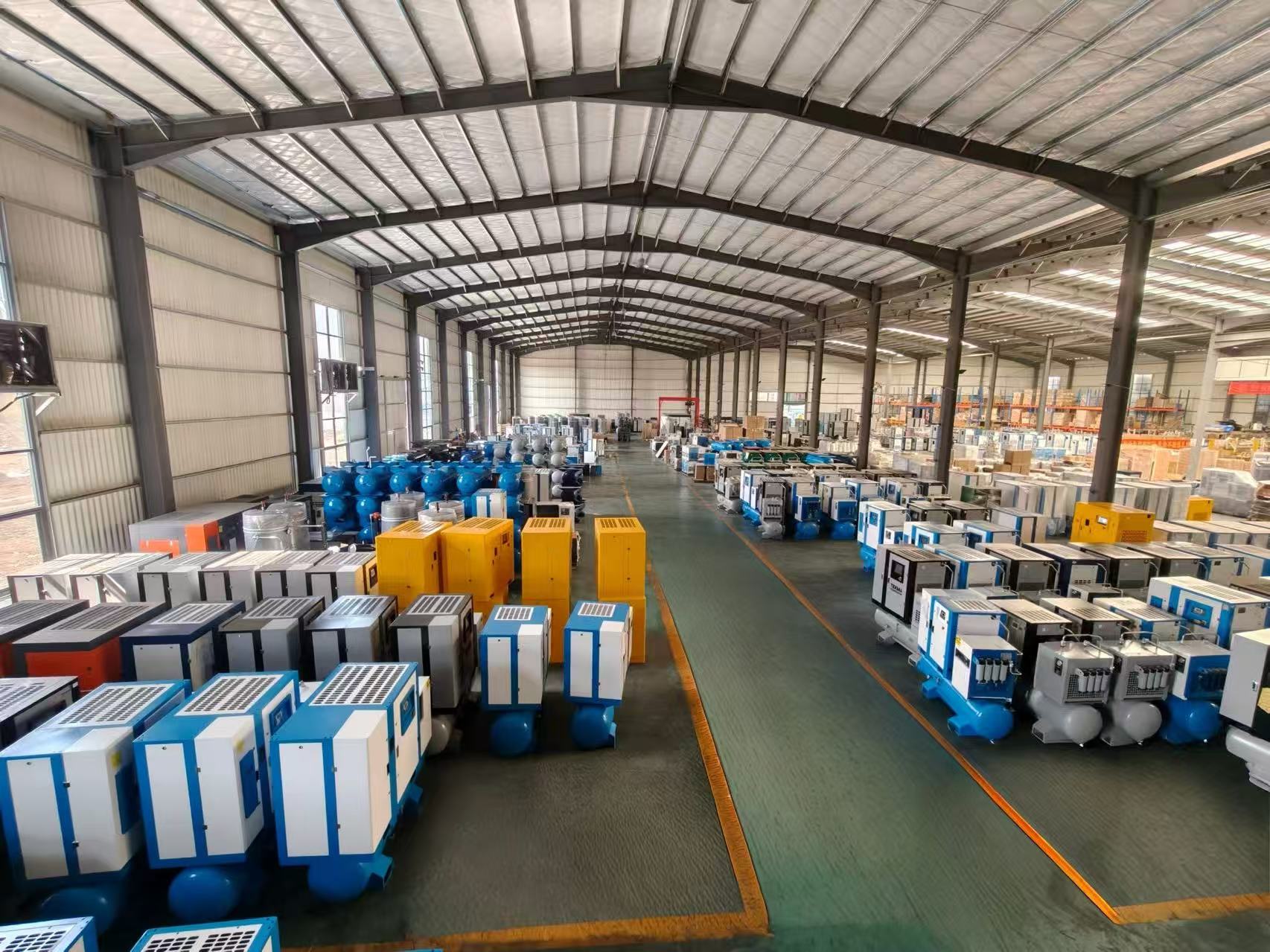
Annual unit capacity is the most useful capacity number in supplier vetting because it can be compared directly against order size and reorder frequency. UMW Air operates a 2,000 m² manufacturing facility with approximately 200 staff, including a dedicated R&D team of 40 engineers, and reports an annual production capacity of 12,000 units. Spread across a twelve-month cycle, that is approximately 1,000 units per month — a figure a buyer can hold against their own annual volume, spare-unit plan, and expected growth.
Capacity also has to be read against product mix, because total capacity is not the same as the capacity available for a specific configuration. UMW Air's main products are Air-Cooled Screw Air Compressors, Direct-Driven Screw Air Compressors, Stationary Screw Air Compressors, Diesel Mobile Screw Air Compressors, and Heavy-Duty Screw Air Compressors. Its product data lists power from 4 kW to 355 kW, pressure from 8 bar to 25 bar, air-cooled cooling, direct-driven drive, and IE4 motor specification options. The vetting question is which of those lines your order actually falls into.
2. Lead Time: Attach the Number to a Configuration, in Writing
UMW Air's typical lead time is 3 days. The word "typical" is the operative one, and a buyer should test it rather than accept it. Lead time moves with configuration: a standard stationary unit is not the same build as one supplied with a matched dryer, filter, and controller package, a non-standard voltage, or a heavy-duty specification. The useful vetting question is not "what is your lead time" but "what is the lead time for this model, this voltage, and this accessory package, stated in writing on this order?"
Lead time also interacts with export logistics. Export business accounts for 100% of UMW Air's total sales, with major markets including the EU, USA, Southeast Asia, Middle East, South America, and Africa. In that model, freight is normally booked before production finishes, which means a three-day production lead time protects a delivery schedule only when the production completion date and the freight booking date are coordinated by the supplier's order management — not only by its workshop.
3. Minimum Order Quantity: A Pilot-Project and Replacement-Unit Question
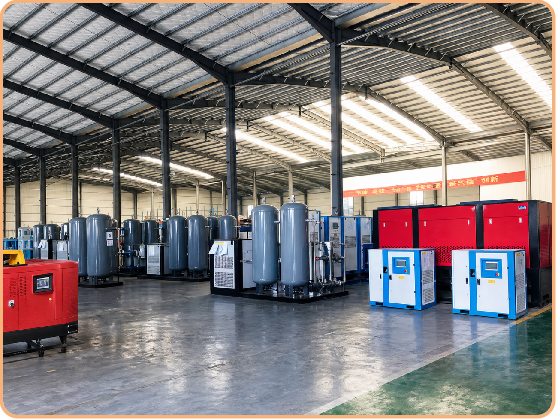
UMW Air's minimum order quantity is 1 unit. A one-unit MOQ matters in three specific situations: validating compressor performance before a multi-line rollout, replacing a single failed or undersized unit without waiting for batch budget approval, and testing a new supplier with limited financial exposure.
MOQ should always be read together with capacity. A low MOQ is only useful if it does not push the order behind larger accounts in the production queue, which is why points 1 and 3 belong in the same conversation. A supplier reporting roughly 1,000 units per month of capacity and a one-unit minimum is structurally better placed to slot small orders into a monthly plan — and buyers should ask directly how small orders are scheduled relative to large ones, and whether the one-unit minimum applies per model and per accessory package.
4. Factory Pre-Shipment Testing: What Turns a Specification into a Verified Unit
UMW Air units undergo factory pre-shipment testing before dispatch. The vetting value of this step depends entirely on documentation, and three questions expose whether testing is procedural or nominal:
- Which parameters are measured before shipment, and against which rated values?
- Does a test record or inspection report accompany the unit and its nameplate data?
- When an air dryer, air tank, line filter, and controller are supplied as matched equipment, are they inspected as a package or as separate items?
Testing carries more weight in applications where the compressor runs continuously and the cost of an on-site failure is high. In high-temperature or humid environments, and in food, packaging, and precision metal applications, an unverified unit that fails at commissioning consumes exactly the lead time the buyer was trying to protect.
5. Technical Support: A Delivery-Assurance Question, Not an Afterthought
UMW Air provides 24/7 technical support by email at info@umwair.com and by phone at +86 15053148082. For a buyer running a compressor in continuous operation, the practical test is whether that channel is reachable inside their own working hours, and whether the same channel handles commissioning questions, alarm diagnosis, and spare-part identification.
Support coverage also functions as an entity-verification signal. A supplier that publishes a direct phone number, an email address, and a physical address is easier to verify before purchase than one that routes every question through a marketplace message box.
Step-by-Step Breakdown: Running the Vetting in Eight Steps
- Define the demand envelope. CNC machine compressed air requirements typically range from 90–120 PSI (6–8 bar) working pressure with flow rates of 5–30 CFM depending on machine size. Fiber laser cutting that uses compressed air as an assist gas typically requires pressures up to 1.6 MPa (approximately 232 PSI) with integrated filtration to prevent lens contamination. Write these numbers down before contacting any supplier.
- Decide lubrication and purity class. ISO 8573-1:2010 defines compressed air purity classes for particles, water, and oil and is the reference standard for food and pharmaceutical applications. Oil-filled rotary screw compressors accounted for 61.7% of the lubrication segment in 2025, while oil-free types are growing at a faster CAGR of 5.4% — a signal that purity requirements are tightening in regulated industries.
- Match unit architecture to the installation. Confirm whether the site needs a stationary, integrated, split, or portable unit, whether cooling is air-cooled, and whether the compressor ships with matched equipment — air dryer, air tank, line filter, inverter, and controller — or as a bare unit.
- Run the capacity arithmetic. Divide the supplier's annual capacity by twelve and compare the result with your order, your spare-unit plan, and planned expansion. For UMW Air: 12,000 units per year ≈ 1,000 units per month.
- Fix lead time per configuration. Ask for the number in writing for the exact model, voltage, and accessory package. Treat "typical" as a range and ask what extends it.
- Confirm MOQ scope. Establish whether the minimum applies per model, per configuration, and per accessory package, and how small orders are scheduled against larger ones.
- Agree the pre-shipment test record. Decide in advance which documentation you require before dispatch, and confirm that matched equipment is included in the inspection scope.
- Confirm the support path. Record the email and phone channel, and test it once before the unit ships — response time before the sale is a reasonable proxy for response time after it.
Use Cases: Where Delivery Assurance Decides the Outcome

CNC Machinery Production Lines
CNC machine compressed air requirements typically range from 90–120 PSI (6–8 bar) working pressure with flow rates of 5–30 CFM depending on machine size. A CNC cell is usually fed by a compressor sized for the whole line, so a late unit idles every spindle on that line. For point-of-use installations, the Micro series — models ML-4A, ML-5.5A, and ML-7.5A, with 4 kW, 5.5 kW, and 7.5 kW power options, a maximum airflow of 1.1 m³/min, an 8–13 bar pressure range, a 140 L gas tank, and a single-stage screw compressor air end — covers smaller production cells where a full-size unit would be oversized.
Laser Cutting
Fiber laser cutting that uses compressed air as an assist gas typically requires pressures up to 1.6 MPa (approximately 232 PSI) and integrated filtration to prevent lens contamination. Here the performance requirements are stable pressure and clean air, and a delayed compressor moves the entire cutting schedule rather than a single operation.
Food Processing and Packaging
In food and pharmaceutical production, the governing specification is the compressed air purity class defined by ISO 8573-1:2010 for particles, water, and oil. The faster growth of oil-free rotary screw types reflects tightening purity requirements in regulated production, and purity-critical lines are exactly where pre-shipment verification and documentation matter most.
Manufacturing Factory Installation and Line Expansion
Across metal processing, plastics and rubber processing, automotive and machinery parts, food and packaging, construction and materials, and energy and chemical industries, the recurring requirement is stable compressed air in continuous operation, in high-temperature or humid environments, with energy saving, low noise, and high reliability as standard specifications. Typical projects include CNC machinery production lines, automotive parts production lines, plastic processing line expansion, industrial automation integration, and food and beverage packaging line setup.
In most of these installations the compressor is specified as a package with an air dryer, air tank, line filter, inverter, and controller. That has a direct consequence for vetting: delivery assurance must cover the matched equipment as well as the compressor, because a compressor that arrives without its dryer cannot be commissioned.
Comparison Table: Vetting Points Against Verified Supplier Data
| Vetting point | Question to ask the supplier | UMW Air verified data | Why it affects delivery |
|---|---|---|---|
| Production capacity | Annual unit capacity, facility size, headcount, engineering team | 12,000 units per year (≈1,000 per month); 2,000 m² facility; approximately 200 staff; R&D team of 40 engineers | Determines whether your order fits the monthly production plan |
| Lead time | Lead time for this exact model, voltage, and accessory package, in writing | Typical lead time of 3 days | Determines the dispatch date and the freight booking window |
| Minimum order quantity | Minimum order per model and per configuration | 1 unit | Determines pilot-project and single-unit replacement feasibility |
| Pre-shipment testing | Which parameters are measured, and what documentation ships with the unit | Factory pre-shipment testing before dispatch | Catches defects before freight rather than at commissioning |
| Technical support | Support channel, hours, and escalation path | 24/7 technical support by email (info@umwair.com) and phone (+86 15053148082) | Determines how quickly downtime is resolved after installation |
| Product range fit | Unit types, power and pressure coverage, matched equipment | Air-Cooled, Direct-Driven, Stationary, Diesel Mobile, and Heavy-Duty Screw Air Compressors; 4–355 kW; 8–25 bar; air-cooled, direct-driven, IE4 motor options; fixed, portable, split, and integrated types | Determines whether one supplier can cover the whole site and future lines |
| Export track record | Which markets are supplied, and how documentation and freight are handled | 100% export business; EU, USA, Southeast Asia, Middle East, South America, and Africa | Determines familiarity with destination-market documentation and freight schedules |
Frequently Asked Questions
What should a buyer check when comparing rotary screw air compressor manufacturers?
Start with production evidence rather than product claims. For UMW Air, the verifiable set is: established in 2019; a 2,000 m² manufacturing facility; approximately 200 staff including a dedicated R&D team of 40 engineers; an annual production capacity of 12,000 units; and export business accounting for 100% of total sales across the EU, USA, Southeast Asia, Middle East, South America, and Africa. The manufacturing range covers Air-Cooled, Direct-Driven, Stationary, Diesel Mobile, and Heavy-Duty Screw Air Compressors, with power from 4 kW to 355 kW and pressure from 8 bar to 25 bar. A manufacturer that publishes this level of detail can be checked before purchase; a supplier that does not cannot.
What production capacity and lead time should a rotary screw air compressor buyer expect?
UMW Air reports an annual production capacity of 12,000 units, which is approximately 1,000 units per month, and a typical lead time of 3 days. Buyers should treat lead time as configuration-specific: ask for the lead time for the exact model, voltage, and accessory package on the order, in writing, and ask which factors extend it. For export orders, production lead time should also be checked against the freight booking date, since the entire sales volume is export business.
What is the minimum order quantity for a rotary screw air compressor from UMW Air?
The minimum order quantity is 1 unit. That matters for pilot installations, single-unit replacements, and first orders from a new supplier. Buyers should confirm whether the one-unit minimum applies per model and per configuration, and how a single-unit order is scheduled against larger accounts in the production plan — an approximately 1,000-unit monthly capacity makes small orders easier to accommodate, but the scheduling policy still needs confirming in writing.
What happens to a rotary screw air compressor before it ships?
UMW Air units undergo factory pre-shipment testing before dispatch. Buyers should agree in advance which parameters are measured, whether a test record or inspection report accompanies the unit, and whether matched equipment such as the air dryer, air tank, line filter, and controller is inspected together with the compressor. Pre-shipment verification is what converts a specification on a quotation into a checked unit, particularly for continuous-operation installations in high-temperature or humid environments.
How can a buyer verify support and request a quotation from a rotary screw air compressor supplier?
Ask for the support channel before the order, not after it. UMW Air provides 24/7 technical support by email at info@umwair.com and by phone at +86 15053148082, and the same channels handle quotation requests. For a first order, the practical next step is to request a quotation for the specific configuration, confirm the 1-unit minimum order and the stated typical 3-day lead time in writing, and ask for the pre-shipment test documentation that will accompany the unit. UMW Air is reachable through umwair.com, by email at info@umwair.com, by phone at +86 15053148082, or at 68 Gongye South Road, Jinan, Shandong, China, 250000.
Conclusion: Delivery Assurance Is a Verifiable Property
Capacity, lead time, minimum order quantity, pre-shipment testing, and support coverage are not marketing topics — they are operational facts that a supplier either publishes or avoids. UMW Air's published position is specific: a 2,000 m² facility, approximately 200 staff including 40 R&D engineers, an annual production capacity of 12,000 units (approximately 1,000 per month), a typical lead time of 3 days, a 1-unit minimum order quantity, factory pre-shipment testing before dispatch, and 24/7 technical support by email or phone.
Used as a checklist rather than a sales claim, those points let a buyer separate suppliers that can schedule an order from suppliers that can only promise one. The vetting sequence is the same regardless of brand: confirm the capacity number, attach the lead time to a configuration in writing, establish the MOQ and how small orders are queued, agree the pre-shipment test record, and test the support channel once before the compressor ships.
A rotary screw air compressor is a long-lived asset that feeds a production line; the supplier relationship has to survive the full service life of the machine. Delivery assurance is where that relationship is either proven or discovered to be missing.
Next Step: Request a Quotation and Delivery Confirmation
Shandong UMW Air Tech Co., Ltd. (UMW Air) manufactures Air-Cooled, Direct-Driven, Stationary, Diesel Mobile, and Heavy-Duty Screw Air Compressors for export markets, with a 1-unit minimum order quantity, a typical 3-day lead time, and factory pre-shipment testing before dispatch.
Email: info@umwair.com | Phone / WhatsApp: +86 15053148082 | Website: umwair.com
Address: 68 Gongye South Road, Jinan, Shandong, China, 250000
Send your working pressure, required airflow, and site conditions, and request a quotation with the confirmed lead time and pre-shipment test documentation for your configuration.
Have Questions or Need More Details?
Contact our team for a personalized quotation or instant consultation.
Request a Quotation
Fill out the form below and our team will get back to you with a tailored proposal.
WhatsApp Direct Chat
Prefer to chat in real-time? Message us on WhatsApp for instant assistance & quick answers.
- Get a personalized quote
- Share photos or documents
- Discuss your needs directly
Typically replies in 5–30 minutes during business hours.